An evil force has descended upon the small town of Shadowbrook; killing the town elders, terrorizing the countryside, and unleashing hordes of minions on the roads to devour all travelers unlucky enough to enter into this sleepy little hamlet. It is up to a motley assortment of playwrights, nobles, and school teachers to save the town and defeat the monster lurking in the shadows. In A Touch of Evil players take on the roles of citizens in colonial America attempting to hunt down this greater evil and save the day. Much like it’s predecessor
Last Night on Earth (the only other offering from Flying Frog Games), A Touch of Evil has multiple scenarios, characters, and a narrative story telling element that runs through the game. I’m a big fan of LNOE so I was eager to give this game a try and see what it had going for it.
The look of the game is very similar to LNOE, with actors portraying the characters and depicting the events on the various cards in the game. Personally, I like the look of it. In some ways it seems a little too slick, but I think it holds together nicely and is certainly a nice change of pace from the art in most games out there. The characters are all represented by somewhat bland grey figurines, they have a decent amount of detail to differentiate themselves from one another, but I found that we all had take a second look throughout the game to make sure that we were moving the right piece. Some of the pieces were also a little bent coming out of the box, Thomas the Courier has a strange lean to him that resembles Michael Jackson in the Moonwalker video. There are also a ton of small cardboard tiles that go along with the game. They represent minions, attribute boosts, wounds, and a million other aspects of the game. Some tiles don’t really have a function in the game; players are encouraged to create scenarios and use these extra tiles. I don’t think this open philosophy works as well in TOE as it does in LNOE since the game is essentially wed to the basis of heroes hunting down a monster, as opposed to LNOE where the goal for each game can vary greatly with both the heroes and the zombies being the protagonist in any given scenario. I don’t see how TOE can exist as anything other than the heroes going after the monster, though I suppose some custom scenarios can add a twist to this.
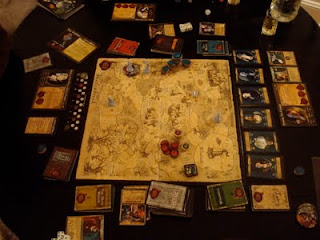
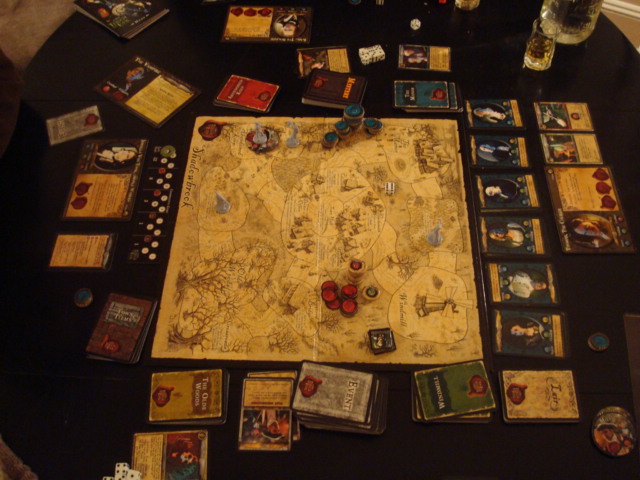
Another aspect of the components that really jumped out at me when I was opening the game was how small the actual game board is. Really, it’s almost tiny which I found to be silly. Then we played and noticed how many peripherals wind up surrounding the game. There are numerous stacks of cards, counters, minions, the villain sheet, the characters, and others. Taking those into account the game actually has a pretty big footprint on one’s gaming table. So clearly it was a good idea to make the board on the smaller side, otherwise it would actually be pretty gigantic.
The object of the game is to hunt down the creature to it’s lair and defeat it in combat, thus saving the town. There are four possible villains operating behind the scenes. The Spectral Horseman, Vampire, Werewolf, and Scarecrow each have different powers and minions to unleash on the heroes. It is also possible for no player to emerge victorious and for evil to triumph. The game contains a shadowtrack that starts at 20, throughout the game certain actions cause it to go down. If the shadowtrack ever goes below 1 then the game is lost as the villains hold on Shadowbrook becomes complete. Scary times. The cost of purchasing a lair card also decreases as the shadowtrack moves down, which figures into the strategy in the game.
The game itself plays pretty easy for the most part, though the end showdown with the villain seems a little bit confusing. Players go in order (beginning with the First Player, a title which moves each round) and only have a couple of choices available to them. They roll and move around the board, fight any monsters they may pass, and then encounter the space that they are in. Encountering the space can produce a myriad of results; from being attacked by a minion, finding a treasure, drawing an event card, and others. After this they can also purchase a lair card, peek at a town elder’s secret, or heal a wound. Very easy to manage. After each player has done this a Mystery card is drawn and the results applied. The Mystery card represents the villain exerting his power over the area and usually has negative consequences for everyone involved. It’s similar to the Infection deck in Pandemic or the Black cards in Shadows Over Camelot.

When a lair card has been purchased a player may travel to the location named on the card and fight the villain, with victory in this combat winning the game. The villains are very tough and help is usually required in the battle, help which takes the form of the town elders. A group of six mysterious citizens, the elders come to the aid of the hero in the climactic showdown. Before the fight begins the hero has the option of taking up to two of these people to assist in his fight, but there is a twist. At the start of the game each elder is randomly given a secret card. Some of the secrets have no effect, some have a positive affect, and others are negative and take the form of the elder secretly plotting with the villain. Because of this it is essential that the player investigate the elders before enlisting their aid, it’s a nasty surprise to find out that your ally Lord Holbrook is actually in cahoots with the evil Scarecrow. Once an elder has been revealed as evil he stays with the villain for the rest of the game. I think. This is one of the areas where the game is not all that clear on what happens. My biggest complaint with the showdown is that in both of the games that we played the same thing happened. One of the players challenged the villain and damaged it, but eventually came up short. Right after this the next player challenged it and was able to defeat it because the villain did not have a chance to heal it’s wounds. It doesn’t seem all that heroic to sneak up on the vampire and take him out because someone else brought him to death’s door.
The general theme of the game is that the players are investigating the mystery and ultimately trying to track the villain down to his lair and slay it. Feeding into this players collect investigation points for most things that they do. Battle a minion and kill it? Get some investigation points to reflect what you learned from it. Encounter a creepy scene in the Abandoned Keep? Investigation points represent clues left at the spot. Investigation points are essentially the currency of the game and can be used to purchase items, learn secrets, and hunt down the monster.
The heroes in the game are an interesting mix of colonial types. We’ve got a soldier, some nobles, an investigator, even a playwright. The characters in the game all have a special ability or two, and a score in four attributes; Spirit, Cunning, Combat, and Honor. These stats are frequently used to determine the success of an investigation using a target number system. Example: when encountering a ghost in the Olde Woods a player is required to make a 5+ Spirit check, with each result garnering an investigation point. Say you have a Spirit of 3, you would then roll 3 dice and each result of 5 or higher counts as a success and gets you a point. Areas of the board focus on certain skills, so it makes sense to hang around the Windmill if Cunning is a strongpoint for your character.
Combat is also an integral part of the game, with the heroes frequently finding themselves waylaid by Barghest Hounds and Ghost Soldiers. One of the aspects of combat that I do like is that all the rolls are resolved simultaneously, so even if you kill the Feral Kin in one round it still has a chance to inflict some wounds on you. One of the odder aspects of combat, and one that I don’t like as much, is that you can’t really get killed. If a character fills up all their wound markers they are merely moved back to Town Hall, with no long term loss. Due to the sequence of the turn though it may result in the loss of a turn for the character if they are defeated turning the Mystery phase, rather than during their turn.
I’m a fan of games that are able to weave together good mechanics with a plot that works well with the game elements, and this is something that TOE does really well. I like the way that the Mystery cards show the power and influence of the villain in a sneaky way. Like any good mastermind they deal from the shadows and operate in back channels. They assassinate elders, send out henchmen, and corrupt the townsfolk. There is nothing groundbreaking about the way that the game runs, I feel like I’ve seen a variation of just about all the rules in one game or another. But that should not take away from the fun of the game, which is in ample supply.




 Posts
Posts

