If there is one thing that Smallworld doesn’t need it’s probably more Races and Special Powers. A better tray to organize them perhaps, but the Races and Powers have everything pretty well covered. Of course that did not stop me from indulging in the Grand Dames of Smallworld expansion, which focuses on several new all female races to make the game that much more expanded. Or something like that. It has three new Races and two new Special Powers, all of which fit well into the game. One thing that I do like about it is that none of the Races or Powers are particularly overpowering, which is frequently a pitfall of many expansions. This one is pretty good though. I also think it's fitting that two of the Races have powers centered around going into decline, since they are all female that is probably going to happen pretty quick with no one to reproduce with. So what do we have here?
The three races are the ghostly White Ladies, the pious and somewhat insulated Priestesses, and the wandering Gypsies. All of them are user generated contributions, apparently Days of Wonder had some sort of contest and got people to send ideas in to them and then made the best of them. They did a good job. The White Ladies are kind of tough to play, but can pay off in the right circumstances. Since they are ghosts they pretty much stick around forever, haunting your opponents with their ability to just sort of hang around. Their special power is that once they go into decline they become immune to conquests and powers, making them pretty much invincible. The winning combo here is Stout White Ladies to start the game. The big issue is that you only get two of them (plus the number from the power) and if they are not available early in the game they are not all that useful. But, if you can spread them out over a couple regions and then go into decline they can really pay off over the course of the game. Think about it, say you are able to conquer three or four regions over the first two turns and then go into decline. For the next six turns they will be paying out three or four coins a turn until the game ends. Not only will they pay better than any other declining race, you also don’t have to worry about defending them. But if they don’t come out early they are not all that useful.
Like the White Ladies, the Priestesses have a power that is triggered when they go into decline. When they throw in the towel all the holy women gather together into a single “ivory tower” in an occupied region. Each turn they score points equal to the number that are holed up inside this temple of learning. So they are essentially digging in and relying on each other for defense. The issue that I have with them is that they are just begging to be attacked. I can’t imagine that a single region that is generating six or seven gold a round is going to last for all that long. Smallworld is sort of all about being mean to one another. This tower has a huge target painted on the side of it. Unlike the White Ladies, it has no additional defense so the Dragon could wipe it out with one move. Ha ha, that sort of cracks me up. And the thing that I don’t understand is what happens to all of them? There is probably a rule somewhere that explains it, but I assume that they are all killed rather than the typical one in a conquered region. I mean, there is nowhere for them to go? I also don’t like the look on their face.
The Gypsies are my favorite of the Grand Dames. For one, sexy ladies in half shirts that are flipping knives in their hand are just sort of cool by nature. I think that we can all agree on that. And their power is original, productive, and really sticks to the stereotypical view of the vagrant gypsies. I am sure that there are many Roma out there who may take issue with them, but I think they are awesome. Every time a gypsy abandons a region they are given a coin for doing so, you just can’t reconquer it this turn. This is good on a bunch of levels. You can actually flee from superior forces, don’t need to worry about defense all that much, and can free up more forces for conquering. Winning! When they are combined with Flying they make one of the most formidable races in the game since they can abandon their area and just go to the most vulnerable spot around. They don’t work as well with powers that generate more coins for specific land types (Forest, Swamp, Hill) since by nature they will want to abandon them, but most powers work real well with them.
The new special powers are not as interesting as the races. Historian gives bonus coins for races that are in decline, going into decline, or when they go into decline. It is very circumstantial to be of any actual use. At most it will generate, what, five coins in a game? That doesn’t really seem to be worth it. Peace Loving goes against everything that Smallworld is about. If you go a turn without attacking an opponent you get three coins. Aside from not being fun at all, I just don’t know when this would work. How are you supposed to do anything without attacking the other rotten races that are trying to inhabit the world that is rightfully yours? No sense. Are you just supposed to sit there and occupy the same spaces all game? Apparently Days of Wonder were going to name this power Boring, but decided against it.
I think that the Grand Dames are a very worthy expansion to Smallworld, however it’s not all that necessary to making it a better game. There are so many possible Race/Power combinations that one could play for a long time before seeing them all. It is very cheap though (I think that mine was ten bucks) so I certainly couldn’t argue with someone who wanted to spice up their game of Smallworld.
Showing posts with label Smallworld. Show all posts
Showing posts with label Smallworld. Show all posts
Monday, March 21, 2011

Sunday, June 6, 2010
Smallworld review
This tiny peninsula just isn’t big enough for all of us. Or even a couple of us. Such is the premise of Smallworld, another excellent offering from the active minds over at Days Of Wonder. In Smallworld 2-5 players vie for control of a small piece of land by using the races of the area to control patches of earth and spread around the region. The catch is that races quickly become overextended and forced into decline, which is really just a reason to dip into the supply and introduce some new genocide to the region. Great family fun! The game is played over a set number of turns and the winner is determined by who has the most points (gold). It should take about an hour and a half to two hours.
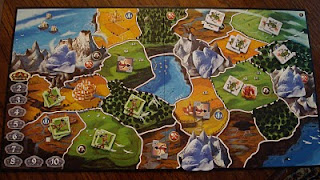 This game is all about the over crowding of a small environ- ment and the actual board does a great job of presenting that concept. Actually there are four boards for the game depending on how many players there are (okay, it’s really two double sided boards), each with fewer and fewer number of regions to conquer. And an actually physically smaller board as well. By the second turn of the game pretty much everything has been conquered and it’s time to start making some enemies by bullying people out of there turf. Land changes hand pretty frequently here. The artwork on the board is good, each different land type is clearly represented and there are a bunch of little details that breath some life into the landscape. I especially like the magical towers that dot the world, ringed with arcane energy it’s not very hard to imagine devious wizards concocting foul schemes within. The races themselves are all represented by small counters, colorful little tiles also with nice depictions. The reverse side of the tile is primarily grey and is used when a race goes into decline. The Ghouls might be the best looking of the bunch (don’t tell the Amazons I said so), though they are all pretty good.
The game turn is very easy and really only consists of two phases. First, a player deploys their forces over the board and conquers new territory, which is just about numbers. An uninhabited land requires two tiles to take over, add an extra for each occupying force on the space. Those hills with two Halflings on them? That will require four of your Giants to take over. Once a turn a player can also call in reinforcements in the form of a die that may allow you to take over a land that you were otherwise short on. When conquering is done, rearrange your forces for defense. The second part of the turn is scoring, which is usually a point for each occupied territory plus any bonuses that may result from a Racial or Special Powers.
One of the great things about this game (and something that really appeals to a strategy/analysis nerd like myself) is the endless combination of Races and Special Powers. And by endless I mean 280 possible combinations. There are 14 Races and 20 Special Powers which are randomly paired with one another as the game progresses. Some combinations are really great (like Flying Sorcerers) and others make world domination an uphill battle (such as the Hill Tritons). It’s really up to you, make the best of it. There is something exciting about the initial draw and the six combinations that come up for choosing. The catch is that for each Race that you pass up on to get to another you have to pay a victory point. Is it really worth paying four gold for those Pillaging Orcs when you can have Underworld Elves for no cost? Hmmm.
Going into decline is a key part of the game, an interesting mechanic, and really what separates this game from being a fantasy version of Risk. When you’ve decided that the glory days of your current race are behind you, you may choose to send your race into decline and choose a new one. When in decline the race loses the Special Power attached to it, though it stays on the board and continues to gain points for you for as long as it is alive (which probably isn’t going to be too long now that you’ve abandoned them). However, you may no longer move them around or conquer any new lands (the Ghouls are the exception to this. Ferocious undead that they are, they continue to feast upon the living even once their creator has written them off). The bad part of going into decline is that choosing to do so is your turn for that round, except if your current race has the Stout Special Power (yes, Stout Ghouls are pretty awesome), so it’s the only thing that you will do. It seems that over the course of a game you will probably play three races. Figuring out which Races and Special Powers work best at different phases of the game is a key ability in Smallworld.

I do really appreciate that some attempt was made at organ- ization in the game design. Too often it’s just not considered in game design and games with a lot of pieces wind up being a mess (see Pandemic and Last Night on Earth). Smallworld could very easily have gone down this road. Instead they did two things right that really enhance the game experience. One is a tray to organize the multitude of game pieces (Flying Frog games, I am staring directly in your direction). There are 14 races and each has around 11 little tiles, that’s a lot of pieces to just be floating around. Since they are constantly used it is important that a player can access them easily. A well organized tray makes a huge impact on the game, and cuts down drastically on set up time. The other time saving organizational aspect of the game is a little more obtuse, but appreciated none the less. This game has a lot of pieces which were all punched out of larger sheets. In the instructions for the game it recommends if you store your games upright or if you travel with them upright that you should place these extra sheets at the bottom of the box. What this does is raise all the trays and boards by about half an inch, thus making them flush with the top of the box. The result is that the loose pieces don’t move around as much. I can’t say that it is perfect, but it’s better than it would have been. As someone who frequently travels with games I really like it. It also makes me think that the designers are actually players and care about this stuff.
I think that Smallworld is a really fun game. Like most games from Days of Wonder it is above all things playable. What does that mean? Well, to me it means that a casual night of gaming meshes really well with it. The rules are easy, play moves quickly, it doesn’t take hours to complete, and most of all it is fun. I know that seems like common sense but some games seem to get so bogged down in a weighty mechanic or too many actions that all the good aspects of the game get buried under the bad parts. It’s not good for anyone. Games shouldn’t be about a designer trying to prove that they have come up with a way to revolutionize the field, they should be about getting together with your friends and enjoying it. The group of people that I play with usually meet on week nights, like to have a couple of drinks during the game, and don’t want to spend hours interpreting abstract concepts (though we certainly have). Days of Wonder has a formula that works really well and I hope that they stick to it.

The game turn is very easy and really only consists of two phases. First, a player deploys their forces over the board and conquers new territory, which is just about numbers. An uninhabited land requires two tiles to take over, add an extra for each occupying force on the space. Those hills with two Halflings on them? That will require four of your Giants to take over. Once a turn a player can also call in reinforcements in the form of a die that may allow you to take over a land that you were otherwise short on. When conquering is done, rearrange your forces for defense. The second part of the turn is scoring, which is usually a point for each occupied territory plus any bonuses that may result from a Racial or Special Powers.
One of the great things about this game (and something that really appeals to a strategy/analysis nerd like myself) is the endless combination of Races and Special Powers. And by endless I mean 280 possible combinations. There are 14 Races and 20 Special Powers which are randomly paired with one another as the game progresses. Some combinations are really great (like Flying Sorcerers) and others make world domination an uphill battle (such as the Hill Tritons). It’s really up to you, make the best of it. There is something exciting about the initial draw and the six combinations that come up for choosing. The catch is that for each Race that you pass up on to get to another you have to pay a victory point. Is it really worth paying four gold for those Pillaging Orcs when you can have Underworld Elves for no cost? Hmmm.
Going into decline is a key part of the game, an interesting mechanic, and really what separates this game from being a fantasy version of Risk. When you’ve decided that the glory days of your current race are behind you, you may choose to send your race into decline and choose a new one. When in decline the race loses the Special Power attached to it, though it stays on the board and continues to gain points for you for as long as it is alive (which probably isn’t going to be too long now that you’ve abandoned them). However, you may no longer move them around or conquer any new lands (the Ghouls are the exception to this. Ferocious undead that they are, they continue to feast upon the living even once their creator has written them off). The bad part of going into decline is that choosing to do so is your turn for that round, except if your current race has the Stout Special Power (yes, Stout Ghouls are pretty awesome), so it’s the only thing that you will do. It seems that over the course of a game you will probably play three races. Figuring out which Races and Special Powers work best at different phases of the game is a key ability in Smallworld.

I do really appreciate that some attempt was made at organ- ization in the game design. Too often it’s just not considered in game design and games with a lot of pieces wind up being a mess (see Pandemic and Last Night on Earth). Smallworld could very easily have gone down this road. Instead they did two things right that really enhance the game experience. One is a tray to organize the multitude of game pieces (Flying Frog games, I am staring directly in your direction). There are 14 races and each has around 11 little tiles, that’s a lot of pieces to just be floating around. Since they are constantly used it is important that a player can access them easily. A well organized tray makes a huge impact on the game, and cuts down drastically on set up time. The other time saving organizational aspect of the game is a little more obtuse, but appreciated none the less. This game has a lot of pieces which were all punched out of larger sheets. In the instructions for the game it recommends if you store your games upright or if you travel with them upright that you should place these extra sheets at the bottom of the box. What this does is raise all the trays and boards by about half an inch, thus making them flush with the top of the box. The result is that the loose pieces don’t move around as much. I can’t say that it is perfect, but it’s better than it would have been. As someone who frequently travels with games I really like it. It also makes me think that the designers are actually players and care about this stuff.
I think that Smallworld is a really fun game. Like most games from Days of Wonder it is above all things playable. What does that mean? Well, to me it means that a casual night of gaming meshes really well with it. The rules are easy, play moves quickly, it doesn’t take hours to complete, and most of all it is fun. I know that seems like common sense but some games seem to get so bogged down in a weighty mechanic or too many actions that all the good aspects of the game get buried under the bad parts. It’s not good for anyone. Games shouldn’t be about a designer trying to prove that they have come up with a way to revolutionize the field, they should be about getting together with your friends and enjoying it. The group of people that I play with usually meet on week nights, like to have a couple of drinks during the game, and don’t want to spend hours interpreting abstract concepts (though we certainly have). Days of Wonder has a formula that works really well and I hope that they stick to it.
Sunday, May 9, 2010
Who Goes First?
Going first in a game usually affords an advantage to that player, though it is not substantial and most likely normalizes over the course of the game. But still, an advantage is an advantage and most games recommend that for the sake of fairness the players roll a die and the highest roller will kick things off. This is fine, and usually the preferred method in the games I play in. However, some games do recommend alternate methods of deciding the first player. Here are some of my favorites, with suggestions to improve them as well.
It makes sense that the starting player of Pandemic is connected to illness, that is after all what the game is about. In this cooperative game the rules state that the player who has been sick most recently goes first. I like this one a lot and in our games we always stick to it. The reason why? It’s always different every time that you play, essentially making it random. I don’t think that this one needs fixing.
One of the stranger methods of choosing a starting player is employed by Smallworld. The player with the pointiest ears gets to go first. Certainly an odd way of picking things, I do like that it rewards such a bizarre personal trait that really may have never come up before in the person’s life. However, like a lot of these methods it winds up being redundant in a group of players that frequently game together. Unless someone is so committed to victory in Smallworld that they alter their ears the same person will continue to go first. Here is my suggestion for an alternate method. Once the initial races are all out on the table the player who most resembles the race in the first spot goes first. Sure, it could cause some hard feelings when trying to figure out who among you most resembles an orc or a ghoul, but really it’s just setting the tone for a game that is all about slaughtering your friends. And if an elf pops up you can still fall back on the pointy ears.
Ticket to Ride rewards the most well traveled of a group of gamers. The initial player is determined by the player who has visited the most places. Like Smallworld this gets old fast, though it does at least have the possibility of changing if you have a long term gaming group. People travel, usually for the reason of improving their chances of going first in Ticket to Ride. Not really, but this game is not really about traveling. It’s about trains. How about the first player is the one who has most recently been on a train? Done.
It’s fun to pick on old people, and clearly the designers of Bohnanza agree with me. In everyone’s favorite game about bean farming, the first player is the player to the left of the dealer. Which is pretty standard fare, however the rules state that the dealer is the oldest player. Ouch. Not only does the elder gamer have to do all of the setup, but then they ultimately wind up going last as well. Not sure what any of that has to do with beans or farming and it also suffers from the redundancy problem, though in a different way (the first player is always changing, but the last player stays the same). My fix is rather simple. Prior to shuffling all the players flip over a single card, the player with the most common bean then has to do all of the shuffling and be the last player. Come on, growing old sucks as it is. Does Bohnanza really need to be against you too?
For a game that is all about being an evil overlord it seems like an odd choice that Dungeon Lords chose to reward the nicest player by having them go first. But I think it is a brilliant way of deciding. There is nothing quite like watching several people argue over who is the nicest among them. It is also the type of thing that is subject to rapid changes based on recent actions. I think that this method is pretty solid, and since in Dungeon Lords players are not really getting a chance to actually kill one another it’s nice to be able to get some animosity out with a healthy argument to start the game.
There is nothing wrong with the random roll of the dice to determine who has the minor advantage of going first, but sometimes a game deserves a little better. Plus, these games all have one thing in common. They don’t use any dice so something else needed to be implemented. (The exception is Smallworld which has the reinforcement die, but it is not a traditional die and could result in a bunch of ties. So we will forget about that one.) I applaud the game designers for coming up with a solution that has some personality to it, even if they are a bit redundant at times.
It makes sense that the starting player of Pandemic is connected to illness, that is after all what the game is about. In this cooperative game the rules state that the player who has been sick most recently goes first. I like this one a lot and in our games we always stick to it. The reason why? It’s always different every time that you play, essentially making it random. I don’t think that this one needs fixing.
One of the stranger methods of choosing a starting player is employed by Smallworld. The player with the pointiest ears gets to go first. Certainly an odd way of picking things, I do like that it rewards such a bizarre personal trait that really may have never come up before in the person’s life. However, like a lot of these methods it winds up being redundant in a group of players that frequently game together. Unless someone is so committed to victory in Smallworld that they alter their ears the same person will continue to go first. Here is my suggestion for an alternate method. Once the initial races are all out on the table the player who most resembles the race in the first spot goes first. Sure, it could cause some hard feelings when trying to figure out who among you most resembles an orc or a ghoul, but really it’s just setting the tone for a game that is all about slaughtering your friends. And if an elf pops up you can still fall back on the pointy ears.
Ticket to Ride rewards the most well traveled of a group of gamers. The initial player is determined by the player who has visited the most places. Like Smallworld this gets old fast, though it does at least have the possibility of changing if you have a long term gaming group. People travel, usually for the reason of improving their chances of going first in Ticket to Ride. Not really, but this game is not really about traveling. It’s about trains. How about the first player is the one who has most recently been on a train? Done.
It’s fun to pick on old people, and clearly the designers of Bohnanza agree with me. In everyone’s favorite game about bean farming, the first player is the player to the left of the dealer. Which is pretty standard fare, however the rules state that the dealer is the oldest player. Ouch. Not only does the elder gamer have to do all of the setup, but then they ultimately wind up going last as well. Not sure what any of that has to do with beans or farming and it also suffers from the redundancy problem, though in a different way (the first player is always changing, but the last player stays the same). My fix is rather simple. Prior to shuffling all the players flip over a single card, the player with the most common bean then has to do all of the shuffling and be the last player. Come on, growing old sucks as it is. Does Bohnanza really need to be against you too?
For a game that is all about being an evil overlord it seems like an odd choice that Dungeon Lords chose to reward the nicest player by having them go first. But I think it is a brilliant way of deciding. There is nothing quite like watching several people argue over who is the nicest among them. It is also the type of thing that is subject to rapid changes based on recent actions. I think that this method is pretty solid, and since in Dungeon Lords players are not really getting a chance to actually kill one another it’s nice to be able to get some animosity out with a healthy argument to start the game.
There is nothing wrong with the random roll of the dice to determine who has the minor advantage of going first, but sometimes a game deserves a little better. Plus, these games all have one thing in common. They don’t use any dice so something else needed to be implemented. (The exception is Smallworld which has the reinforcement die, but it is not a traditional die and could result in a bunch of ties. So we will forget about that one.) I applaud the game designers for coming up with a solution that has some personality to it, even if they are a bit redundant at times.
Subscribe to:
Posts (Atom)


 Posts
Posts

