Showing posts with label review. Show all posts

Friday, December 28, 2012

Dungeon Lords is the best game ever, or The Emperor Has No Clothes

Dungeon Lords is the most interesting, engaging, rewarding and fun board game that there has ever been.  It has pathos and irony, plays great with two, three, or four players, the art is wonderful, and it makes you a better person with a deeper understanding of life when you play it.  Of course, I just sort of have to take your word for it because I actually can’t figure out how to play it.  But everyone says it’s awesome! It has a really high ranking on BoardGameGeek (currently 69th)! It must be the best!

Doesn't this look fun?


At what point is a game not worth playing due to the rules being so complex that the balance of time put into it is not worth the return of “fun” that I am getting out of it?  I’ll let you in on a secret. I play board games because I like them and I find them to be really enjoyable. Enjoyable in the actual moment of gameplay, not because I want to blog about them or to endorse the most obscure game that I can find.  So here’s the deal with Dungeon Lords. I just can’t make sense of it, the game is apparently over my head. The rule book is 24 pages with all sorts of pictures and snarky commentary from monsters! It comes with special boards that have the sole purpose of helping you learn how to play! (So clearly I’m not the only person who has struggled with this.)  I’ve had Dungeon Lords for about two years and not once have we actually played a game through to completion. It’s just too obtuse and far removed from what I want in a game.  I know that this is a personal thing, I’m not damning the entire thing, it’s just not for me.  Actually, I think I might be damning the whole thing.  Who wants to play this? Is it really fun?

I assume that the counter argument here is that once you learn how to play it’s a really great game.  It’s an acquired taste.  But I have so many other games that I really like, so why would I struggle with something in the hopes that one day it will maybe be as fun Ticket to Ride or King of Tokyo? I suspect that Dungeon Lords is actually a great idea more than a great board game.  The concept is awesome.  You take on the role of a monster that owns a dungeon. It is your responsibility to stock the dungeon with traps and monsters, and then adventurers show up and try to take your shit.  And you try to kill them.  Clever and just the sort of role reversal, meta gaming that I really dig.  Except that that the execution of it actually sucks.  There are so many counters and tokens to keep track of, all sorts of different phases to the game that all have their own rules, and the game just seems to move really slow.  Of course, when you have no idea what is really happening it tends to draw your interest away from the actual game. 

After two years I need to admit that Dungeon Lords is just a sunk cost, I will never get anything even close to the $50 that I spent on it back in enjoyment.  I think I may be writing this blog just so I can get some use out of it.  Currently, there is a stack of games on top of Dungeon Lords, it has literally been buried by just about every other game that I have. 

Sunday, April 10, 2011

Master's Gallery review

I’ve really enjoyed both Incan Gold and High Society from the Gryphon Games bookshelf series, so I though that I would give Master’s Gallery a shot, which is another game in the series of quick playing games. At first I was intrigued by what I thought was a pretty clever game mechanic and I enjoyed the quick play. However, subsequent games have left me a little bit disillusioned and feeling like the game actually lacks much strategy and that playing it is sort of like running through the motions without having to think very much. I know, it sounds like a real blast.

Master’s Gallery is a card game for two to five players played over four rounds. There is a deck of 95 Masterpiece cards, each of which is a painting from one of five famous artists; Van Gogh, Monet, Degas, Vermeer, and Renoir. Players take turns placing a card in front of them on their turn, once a single artist has six cards out on the table (five in a two player game) from all of the players combined the round ends and the players score for that round. The artist with the most cards gets a three placed on their artist card, the second most gets a two, and the third gets a one. The other two artists do not score for this round. So, If I have three Van Goghs out when the round ends and each Van Gogh is worth two points I wind up with six points for them. Very easy. Almost too easy, actually. The scoring tokens earned each round stay with the artists for the entire game. Next round each Van Gogh card is already worth two points, plus whatever it may earn on each round. Because of this game mechanic cards are worth much more in the latter rounds of the game since they have been accumulating tokens from the previous rounds, which seems like it should matter a ton but I’m not sure that it does.

The problem is that every time I have played it the game seems to sort of go the same way. Something like this: Player A plays a Renoir, Player B plays a Vermeer, Player C plays another Renoir. It’s now my turn. I have a couple of Van Goghs in my hand that I would like to play, but it’s not really worth it since they will probably wind up with little value. However, if I play a Renoir it is all but assured of being the high valued artist for that round and I want my cards to be worth the most. So I play a Renoir. On the next turn A and C follow suit with another Renoir, as do I and then the turn ends (if it even makes it back to me) and we all share in the wealth of the high valued Renoir. Why wouldn’t I play a Renoir? So I can put down a single Van Gogh and get one point for it, when a Renoir is going to be worth three? It’s just sort of a system that doesn’t reward anything other than joining with the masses and trying to get in on the big score before the round ends. And it will continue each round because Renoir cards are already worth three points, so keep playing whatever Renoir cards that you have!

There are some cards that have an additional action attached to them when they are played, such as playing another card or putting an extra point token on an artist. These make the game even less interesting in a way because they seem to really determine who wins the game. Using the above example let’s say that on his first turn Player A played a Renoir with a symbol on it that allows him to immediately play another card of the same artist. So he has two Renoirs out now. This is just letting Player A end the turn even quicker and score even more points. I have played multiple rounds where one or two players only get to go once before it ends and wind up with practically no points, whereas some players have four cards down thanks to some special powers that they happened to come by randomly. I guess my complaint is that it’s just not very fun and frustrating, and not even in a good way because it made me think hard about strategy. But frustrating because I think I’m playing the game the same way that my cat would play, and that’s not a knock on my cat or myself.

One thing that I really didn’t like about this game is that the description of the game says that the players are art dealers and gallery owners involved with valuing the Old Masters. I didn’t feel that way at all. I just felt like I was putting cards on a table, the thematic implications of those actions were so removed from the game that I didn’t even think about it. Would it have been too much to give each player a sheet that looks like a gallery wall with empty frames? Maybe then I would have at least have had an idea of who I was and what I was doing, rather than just numbly placing paintings on the table. I mean, the word is gallery is even in the title of the game. In comparison Incan Gold is also a rather simple card game, but it tells a nice story and contains a narrative as you go. I felt none of that in Master’s Gallery.

I can’t really complain about the art in this game considering that it is done by some of the great painters in history. I’m not a real big fan of Impressionism, but I can’t really argue with Monet and Degas. Thematically the art is the focal point of the game, which is actually pretty cool. Honestly though, I find myself barely looking at the actual paintings, my focus rarely going beyond the colored border and the symbol that may be in the corner.

In the end Master’s Gallery falls short of being a good game. There just doesn’t seem to be much reason to play. It does only take about 20 minutes to play a game, so I suspect that it will find it’s way onto our gaming table from time to time just because we can play an entire game quickly. When a game’s best quality is that it ends quickly it probably isn’t all that good to begin with.

Saturday, April 2, 2011

High Society review

Once, deeded lands and blue blood were required to be among society’s elite, but now you can just buy your way into the upper crust! In High Society players compete to see who can squander their newly found riches the fastest by amassing a collection of expensive and ostentatious items. Gems! Yachts! A carriage! Okay, so the carriage isn’t quite as exciting but you do need some way to transport all of your new stuff I suppose. Obtain the most gaudy and frivolous wealth and you win! High Society is a quick playing card game for three to five players. The whole thing takes about 20 minutes to play.

Gameplay is very simple. Every player begins with a bundle of cash in a bunch of different denominations. At the beginning of each turn an item comes up for auction and the players take turns bidding on it, with the high bidder eventually winning the stained glass window or the champion thoroughbred. Each of the ten items is valued at somewhere from one to ten (the carriage is worth one, while the chateau on the lake is the most valuable). At the end the player whose items total the most in value wins. It isn’t quite that simple because there are some catches to how you can bid and score.

The real strategy comes in how you bid and spend your money. Each player has eleven money cards to spend, each of a different value from 2 million to 25 million. Once you bid on an item you can’t pull that particular bill from the table, you can only add to it. For example; if you bid 4 million on a painting and then your opponent bids 8 million, you are not allowed to replace your 4 million with a 10 million. You can add a 6 million to it for a bigger bid but that 4 million stays in place. It matters because you may find that you have used up all your small bills when you want some towards the end of the game. It may make sense to lead with a big bill and try to scare the other nouveau riche away from the bidding altogether.

The other tricky things are the negative cards that come up for auction. I’m not sure what sort of auction house allows a Mansion Fire to go up for bid, but unfortunately it is a reality of your situation. The negative cards totally suck for everyone. You are either going to wind up with something that really crushes your final score or you are going to spend a lot to not have to take it. Essentially players are paying to not have the negative event effect you. I actually think that this might be the best part of the game. And it’s also why you need to hang onto some of those small bills, so you can maybe get out of the negative auction without having to throw down some massive dollar amount. Wouldn’t you rather spend it on a castle?

The final twist comes when the game ends. The player that has the smallest amount of cash left in their hand immediately loses. It’s as if the crocodile from Cleopatra wandered over to 19th century America for a snack. So make sure you keep some cash in the bank or all of your worldly possessions mean nothing. The remaining players then add up their total value and adjust for whatever negative cards they have. Someone wins. I’ve seen players win with a single luxury item, often the big spenders find themselves eliminated in the crocodile round.

In some ways High Society has the same pitfalls as Incan Gold in that the art is sort of crummy. I would be way more impressed with the castle and inclined to spend millions on it if it just looked a little more extravagant. The game is really simple, which is why I think it could use a little boost from the art in the game. Don’t get me wrong, the art is not dreadful. But I do think that a game like this is fun when people get into the feel of the game and actually want the items. Which would be easier to do if they actually looked awesome. I like High Society. The best thing about it is that is quick and really easy, but that’s not a knock on it at all. The world needs game like this because sometimes you only have a half hour and still want to enjoy a game.

Monday, March 21, 2011

Grand Dames of Smallworld review

If there is one thing that Smallworld doesn’t need it’s probably more Races and Special Powers. A better tray to organize them perhaps, but the Races and Powers have everything pretty well covered. Of course that did not stop me from indulging in the Grand Dames of Smallworld expansion, which focuses on several new all female races to make the game that much more expanded. Or something like that. It has three new Races and two new Special Powers, all of which fit well into the game. One thing that I do like about it is that none of the Races or Powers are particularly overpowering, which is frequently a pitfall of many expansions. This one is pretty good though. I also think it's fitting that two of the Races have powers centered around going into decline, since they are all female that is probably going to happen pretty quick with no one to reproduce with. So what do we have here?

The three races are the ghostly White Ladies, the pious and somewhat insulated Priestesses, and the wandering Gypsies. All of them are user generated contributions, apparently Days of Wonder had some sort of contest and got people to send ideas in to them and then made the best of them. They did a good job. The White Ladies are kind of tough to play, but can pay off in the right circumstances. Since they are ghosts they pretty much stick around forever, haunting your opponents with their ability to just sort of hang around. Their special power is that once they go into decline they become immune to conquests and powers, making them pretty much invincible. The winning combo here is Stout White Ladies to start the game. The big issue is that you only get two of them (plus the number from the power) and if they are not available early in the game they are not all that useful. But, if you can spread them out over a couple regions and then go into decline they can really pay off over the course of the game. Think about it, say you are able to conquer three or four regions over the first two turns and then go into decline. For the next six turns they will be paying out three or four coins a turn until the game ends. Not only will they pay better than any other declining race, you also don’t have to worry about defending them. But if they don’t come out early they are not all that useful.

Like the White Ladies, the Priestesses have a power that is triggered when they go into decline. When they throw in the towel all the holy women gather together into a single “ivory tower” in an occupied region. Each turn they score points equal to the number that are holed up inside this temple of learning. So they are essentially digging in and relying on each other for defense. The issue that I have with them is that they are just begging to be attacked. I can’t imagine that a single region that is generating six or seven gold a round is going to last for all that long. Smallworld is sort of all about being mean to one another. This tower has a huge target painted on the side of it. Unlike the White Ladies, it has no additional defense so the Dragon could wipe it out with one move. Ha ha, that sort of cracks me up. And the thing that I don’t understand is what happens to all of them? There is probably a rule somewhere that explains it, but I assume that they are all killed rather than the typical one in a conquered region. I mean, there is nowhere for them to go? I also don’t like the look on their face.

The Gypsies are my favorite of the Grand Dames. For one, sexy ladies in half shirts that are flipping knives in their hand are just sort of cool by nature. I think that we can all agree on that. And their power is original, productive, and really sticks to the stereotypical view of the vagrant gypsies. I am sure that there are many Roma out there who may take issue with them, but I think they are awesome. Every time a gypsy abandons a region they are given a coin for doing so, you just can’t reconquer it this turn. This is good on a bunch of levels. You can actually flee from superior forces, don’t need to worry about defense all that much, and can free up more forces for conquering. Winning! When they are combined with Flying they make one of the most formidable races in the game since they can abandon their area and just go to the most vulnerable spot around. They don’t work as well with powers that generate more coins for specific land types (Forest, Swamp, Hill) since by nature they will want to abandon them, but most powers work real well with them.

The new special powers are not as interesting as the races. Historian gives bonus coins for races that are in decline, going into decline, or when they go into decline. It is very circumstantial to be of any actual use. At most it will generate, what, five coins in a game? That doesn’t really seem to be worth it. Peace Loving goes against everything that Smallworld is about. If you go a turn without attacking an opponent you get three coins. Aside from not being fun at all, I just don’t know when this would work. How are you supposed to do anything without attacking the other rotten races that are trying to inhabit the world that is rightfully yours? No sense. Are you just supposed to sit there and occupy the same spaces all game? Apparently Days of Wonder were going to name this power Boring, but decided against it.

I think that the Grand Dames are a very worthy expansion to Smallworld, however it’s not all that necessary to making it a better game. There are so many possible Race/Power combinations that one could play for a long time before seeing them all. It is very cheap though (I think that mine was ten bucks) so I certainly couldn’t argue with someone who wanted to spice up their game of Smallworld.

Sunday, December 26, 2010

Incan Gold review

There is an awful lot of exciting adventure contained in this small card game. Incan Gold casts the players as members of a team exploring the tunnels of an Incan ruin, searching for gold and the rumored treasures of a lost civilization. Like in Forbidden Island, I’m not sure if I am taking on the role of a grave robber and looter, or someone with more idealistic views. I’m not sure it matters, I’m comfortable with both. What I do know is that Incan Gold is a ton of fun and is probably the best “fast” game that I’ve played. Three to five players can get in on it and a whole game can easily be completed in fifteen minutes.

The game is simple. Each round players decide if they are going to return to camp and keep what they have found, or they are going to try to find more treasure by continuing in the tunnel. Players reveal their choices simultaneously, so predicting what others do is a part of the strategy. If you go to camp everything that you have found so far is safely banked (or tented, as the case may be) and you are done until the next tunnel. If you bravely light up that torch and keep going, then the next card is flipped over and everyone still exploring splits whatever loot they find. This is usually a room of a variable amount of treasure. There are also artifacts that have a value determined by when they come up in the game. Sometimes there are mummies though! And also spiders, cave ins, fire, and snakes. Once a pair of the same hazard comes out the tunnel is done and anyone still inside loses everything that they have found that round. The game is played over five rounds.


One of the aspects that makes Incan Gold so much fun is that because it is so fast it gets you in the mood to gamble, which is when the excitement really comes in. Knowing that you are going to have another shot in a moment makes even the most conservative gamer want to roll the dice. Sure, the tunnel may be collapsing and filled with snakes, but the lure of gold is very hard to resist. The fun really starts when one or two players have headed back to camp like the wimps that they are, leaving the remaining players to get a larger share of the loot. I shouldn’t be so quick to judge, discretion is the better part of valor after all. And there are some clear advantages to bailing early and leaving your friends at the mercy of giant spiders. For one, you get to keep all your treasure. That’s big. And you also get any treasure that has been left out in the tunnel. When treasure is divided it is rounded down and any of the leftovers stay in the tunnel to be picked up by whoever gets to them first. This is also how artifacts are obtained.

Since players are really just making one decision over and over (stay or go) there is not a ton strategy, but the concept of greed is as ancient as mankind and doesn’t appear to be losing steam. It’s about how far you think you can push it. As more and more hazards pile up the chances of pairing one become much greater. As a result player leave, the shares get bigger and someone always gets greedy. I love it. And you think that you know who is going to do what, but your friends will surprise you.

I like the pieces of treasure in the game. They are turquoise, obsidian, and gold and it’s fun to put them inside of your own little tent. Other than that the game is just cards. The art is mediocre, but it doesn’t bother me much in this game. They are never in your hand, turn over real fast, and it’s just the same couple of designs over and over. Except for the artifacts.

Artifacts of the Incans

About the only aspect of Incan Gold that I do not like is the quality of the artifact cards. As far as I understand this game was originally released as Diamant, the only difference between the two games is the inclusion of the artifacts in Incan Gold. Thematically I like the artifacts, it’s always fun to have a little bonus pop up along the way and see how the players fight over it. However, the art on them is really just of odd. There is not a ton of art or production that went into Incan Gold, it’s a card game that doesn’t require it. But if you are going to include the artifacts then they should be cool. As it is, I don’t even know that they are. There is the weird tetris block looking man, some sort of crummy necklace that looks like it would behead you if it was worn, something that looks like a rocket ship with eyes, and a gold cup. A cup! Come on, the Incans must gave been hoarding better treasure. I don’t know. Yes, I am picking nits but I think that Gryphon Games blew an opportunity to do something fun with them.

Incan Gold is an awesome game. It’s fun for a casual, quick night of gaming when you play games. It’s great for new players since the rules and concepts are so simple. It’s great for kids for the same reasons. And it’s relatively cheap. A worthy addition to any game library.

Sunday, December 19, 2010

Cleopatra and Society of Architects review

Ever the fickle diva, Cleopatra has demanded a brand new temple to honor her and has gathered a group of architects to construct the marvel. In Cleopatra and the Society of Architects players take on the role of the architects. Using a variety of materials they must construct the temple and impress the Queen when she comes to inspect it, lest she feed you to her crocodile! The game is for three to five players and takes about an hour. Like many games with a lot of components it appears somewhat daunting at first, but it is actually a very easy game to play. And a lot of fun.


Days Of Wonder have outdone themselves with the components of this game. The best part is clearly the actual temple, which is constructed over the course of the game. It consists of columns, obelisks, sphinxes, a throne and other parts that are culled from the local quarry in the hopes of pleasing the Nile Queen. I have to say, it’s actually really cool to assemble the temple piece by piece. There are a million games where things are constructed and usually the most that one can hope for is some cardboard pieces that represent the construct. This far exceeds that. The way that the game box is incorporated is very clever, the pieces looks great and they even fit well into the box when it’s all over. Well done. My only complaint is that due to the height of the palace grounds (built on top of the game box) it is hard for all of the players to see what is going on (I had a similar problem when trying to take a picture of it). The non-palace pieces are mainly little cardboard chips that represent points and corruption amulets (more on that later) and they are fine. There are also little statues of Anubis that each player gets. Who doesn’t like little statues of Anubis?

In many aspects the game plays a lot like Ticket to Ride (a favorite at our gaming table) in the sense that there are only two actions available to a player each turn; get resources, or spend those resources to build something. The resources come from the Market, which are three stacks of cards that the player can choose from. Players can take one stack, after which an additional card is placed on each of them. When the game is setup the deck is shuffled in a strange way so that some of the cards are face up and others are face down, meaning that the market stalls have face down cards in them so that you don’t always know what you get. Interesting. Throughout the game the stacks are usually of varying sizes, but you don’t always want to take the most resources because some of them are tainted. Yes, there are corrupt merchants out there and Cleopatra frowns on your association with them. Apparently the black market for Lapis Lazuli was thriving in ancient Egypt.

The other available action for players is visiting the quarry and building a part of the temple. Each temple piece costs some combination of resources (this is very similar to Settlers or Starfarers of Catan) to build. For example; building a sphinx costs a player one artisan, one stone and one marble. Completing a temple piece is also worth talents, (the fancy name for points) which ultimately decide the winner of the game. There are only a certain amount of each temple part available and this determines when the game ends. Each time a part is exhausted Cleopatra gets a little closer to her inspection. When five (of six) are completed the game ends and Cleopatra passes her final judgment on the glorious temple that has been built to honor her. The game ends rather abruptly, there isn’t a final go around or even much warning so it’s important to pay attention to what is left in the quarry or you may be left with a bunch of unspent resources in your hand. And that does not make Cleopatra happy.

Choosing which pieces of the temple to build appears to be one of the key strategies of the game. Some of them are just worth a lot more than others. The throne, for example, gets a player twelve talents, whereas a sphinx may only get you two. Huge difference. Building up some resources early on and then going for the high value pieces is the way to do it. Like TTR, it makes more sense to go for the big ones rather than an accumulation of smaller parts. There are also additional talents to be won when placing the mosaic tiles and the column walls, so competition to get these is the right spot adds another element to the strategy.

Throughout the game players get corruption amulets whenever they engage in shady building practices by using tainted building materials, dealing with characters like the Vizier and Courtesan and by hoarding more cards than the ten card hand limit. Each player has a little pyramid with a coin slot in it that the amulets go into, they stay hidden from the other players. I like having my own private pyramid that hides my shame from the other players, and the reveal at the end is rather tense. When the game ends the most corrupt player is eaten by Cleopatra’s crocodile and loses the game automatically. I think that’s a great feature. I also like that it’s fine to be corrupt, as long as you are not the most corrupt. I think there is a lesson in there.

I think I’ve said this before but I really like what Days of Wonder are doing these days. The games that they make are consistently fun, the rules are well presented and easy to understand, and the games usually have great components and themes. Cleopatra is another excellent addition to their catalogue. It doesn’t seem to have the depth of a great game, I’m not sure that there is really a variety of styles that can be rewarded. To me, a great game allows players to play in a variety of styles and be successful. Ticket to Ride and Starfarers of Catan are the first that come to mind, but Cleopatra is still a very good game and one that I think is good for luring in novice gamers.

Monday, November 1, 2010

Castle Panic review

Building your castle right in the middle of the forest was probably not the smartest idea, so you shouldn’t be all that surprised that monsters are coming out of the woods to tear it down. Such is the dilemma of Castle Panic, from Fireside Games. Castle Panic is a cooperative game in which the players must defend their castle from hordes of goblins, orcs and trolls. The monstrous horde reigns victorious if they are able to destroy the castle, the players are triumphant if they defeat the entire gang of monsters laying in wait. Castle Panic is for one to six players and takes about 45 minutes. I think that it's a fun game and a great introduction to cooperative board games due to it's simplicity, but ultimately it lacks the depth and strategy that would allow it to be a great game. 

The castle consists of six towers in the middle of the board surrounded by six walls that help to defend it. Working from the inside out the castle is surrounded by several colored rings; swordsmen, knights, archers and the forest. Monsters in the forest are in wait and can’t be attacked until they emerge, monsters in the other rings can be attacked by the appropriate soldier. Example: a troll that has moved into the Knight ring in the green section can be attacked by a Green Knight card. Monsters are randomly placed in the forest when they come into the game and on each turn they move one step closer to the castle, ultimately destroying the walls and moving onto the towers. There are 49 monster tokens in the beginning of the game and the players have to defeat them all in order to achieve victory. The game sort of works as a puzzle as the players attempt to piece together the best offense by anticipating where monsters will wind up on a given player’s turn.


Each turn the players have a chance to trade cards with one another, and if the game has a key strategy it is trading cards between castle defenders. The strategy is simple to grasp and, unfortunately, does not get much more complex which does not bode well for repeated plays of Castle Panic. Most of the moves are self evident. If there is a goblin in the Red Archer zone and one of the other players has a Red Archer, you should trade for it. You can only trade once per turn so it is important to prioritize and make sure that the trade you make is the best one available. Aside from that you should just kill anything that you can reach.

The oddest thing about Castle Panic is the Master Slayer. When a player defeats a monster they claim it’s monster token and at the end of the game players total these up and the one with the most points is given the title of Master Slayer. So, everyone wins but one player wins more than the others? That seems real weird to me and does not mesh all that well with the team dynamic. I suspect that the designers probably added this to increase the competition in what is generally a pretty easy game. But I’m not so sure about it.

The game components are simple and do the job. There is not much to the game. Castle Panic consists of some towers, some walls, monster tokens and a deck of cards. The art is just okay. I would like to have seen some variation amongst the creatures that are attacking. The orcs all look the same as one another, they must have some real military discipline going in on those woods to get the traditionally chaotic creatures to all agree to the same uniform. I do like the Boss monsters that lead the others. The best components are the actual walls and towers. They are on little stands and lend some depth to the board. They fall into the unnecessary but enhances the game category. The board is sort of bland and the one I have is a little crinkled around the edges. I would like to have seen maybe some enemy encampments, siege engines, or really anything else put on the board just as a meaningless detail. As it is it is just a big field with circles on it.

I think that the biggest issue I have with Castle Panic is that it seems to be pretty easy. Actually, it seems to be real easy. I’ve played the game about a half dozen times now and only once did I actually feel panicked, which I sort of assumed to be the signature emotion of the game. A cooperative game needs to be hard. It is one of the reasons why Pandemic is such a success, most of the time you are probably not going to win. It’s creates tension and drama and a nice feeling of accomplishment when you finally succeed. Same thing with Shadows Over Camelot. There are suggestions in the instructions about making the game harder, the most difficult of which is the version in which the castle starts with no walls, just the towers to defend. It was close, but we were able to defeat that one as well and I’m just not sure where we take the game from here. I’m not sure how much our game group will continue to go back to this game since we will keep winning. I don’t need the ego boost that comes with continued winning, I’d prefer the challenge that makes a great game.

Monday, October 25, 2010

The Game of Real Life

I was given the Game of Real Life by a friend, who had it given to them by someone else. Other than Hot Potato a game should not be passed around this much, so I was a bit leery about this game from the start. The Game of Real Life is a more realistic approach to the Game of Life, the classic game of happy endings. Apparently real life is filled with nothing but drugs, prostitution, early death and pain. I suppose that’s not entirely false and actually makes a decent premise for a game. Honestly though the game is not much more than a “roll the dice, move your mice” with some colorful details and some options along the way. But, like real life, much of the decision making is really out of the player’s hand. The game is for two to six players and should not take more than a half hour, considerably less if a couple players meet unfortunate endings. Which they probably will.

The best part of the game is the diary. All the players are given a diary sheet to keep track of their life events. It’s nothing all that special, but I like that the game creators wanted to put some sort of element into it that gives it some life. It’s nice to be more than just the sum result of some dice rolling and a score at the end. The problem is that you think that the diary will be a nice, flowing narrative of your character’s life when it is actually just a bunch of short sentences summarizing what happened to you. The game turn is very quick (just roll and read) so it does not leave you with much time to create flowery prose.


The object of the game is to be the player who has the most happy faces at the end of the game. Living for a long time helps because it allows you more time to collect happiness, but it is possible to win even if you die early if those are some real happiness filled years of youth. Happy faces are gained by all sorts of activities; marriage and kids, vacations, and many other things such as your own pizza, catching leaves on a fall day and seeing a unicorn in the forest. Strangely, the single biggest happiness provider in the game is found on the heroin chart. Granted, some of the other heroin uses create disastrous situations, so it’s not always a happy ending. It’s really not a happy ending in most situations. Cris, Mike and I played the other night. Mike was a drug addict witness to an infant having their throat slit, Cris was a prostitute that died in World War III and I perished in a nightmare of a nursing home. At least I made it to old age, not bad for someone who was disowned by their family, shot in a drive by and had some bad experiences with LSD.

The board itself is a blur of lines, small type, colors and some drawings. It is very confusing and the fact that the print is so tiny and facing off in all directions makes it very hard for the player to read what is going on. What space am I on? Can you read that for me? And the game pieces are rocks. Actual rocks. I suppose they are little bit glossy actually. I don’t mind the low-tech approach to the game, but the design of the board could have been a lot better. It’s not just that it does not add a ton to the game, but I would say that it actually detracts since it slows things down as you try to figure out the space that your rock just landed on. And the spaces are very little. Also, maybe we had too much wine when we were getting started but it took us several minutes just to locate the starting point on the board. Not a great sign.

The Game of Real Life is fine if someone wants to give it to you, but I’m not sure that I would recommend buying it. If you are used to Life and Monopoly than it will probably be exciting and funny and perhaps an impetus to look further into the world of board games, which is a great thing. I’m not saying that I will never play it again, but it is not at the top of the list.

Monday, August 30, 2010

Forbidden Island review

Without knowing much about it I picked up Forbidden Island for a couple of reasons. It was cheap (only $16, which is stupidly cheap for board games), had very nice packaging and it was by Matt Leacock, creator of the awesome Pandemic. I was a little hesitant because it was purchased in a toy store that had pretty much just stuff for little kids and I’m 31 years old. But I bought it anyway and I’m very glad that I did. The premise is neat; a group of adventurers travel to the infamous Forbidden Island to loot it of it’s four treasures. The only problem is that the ancient civilization that guarded the treasures has booby trapped the island, making it a watery grave for anyone who tries to steal the valuable artifacts. It is for two to four players, should take less than a half hour and is very simple to learn and play.


When I started to read through the rules one thing became clear right away. This game is Pandemic, just with a different storyline. Honestly, it plays almost exactly the same. Instead of curing the four diseases the players have to find the four treasures by using four matching treasure cards. Instead of outbreaks and infections in cities certain island tiles become flooded. Instead of Infection cards we have Waters Rise, which causes the deck to be reshuffled and increases the number of flooded tiles each round. Even the player roles are very similar. It may not be the most original game concept, but that does not take away from the fun of it at all. It’s a great game.

One thing about Forbidden Island that is top notch is the art and packaging. The game comes in a nice looking tin and everything fits easily inside of it. The island is comprised of randomly placed tiles (so the layout is different each time) and the art in them is super cool. They are all sort of ominous and forbidding (maybe that’s where the island’s name comes from…) and each one unique. They are not generic things like mountains and coast, but Breaker’s Bridge and the Cave of Shadows. The Coral Palace may be my favorite. Seriously very cool. Everyone that I have played with has commented on the art. But the best part is the actual artifacts that you have to collect. Each one of the four is represented by a little figurine and, like the tiles, are really very nice. I think that my favorite is the Ocean’s Chalice because of the tentacles on the stem of the goblet, but I would listen to arguments for all of them. One aspect of them that I really like is that they are in the game just to be a nice addition, they are not necessary at all. They could easily be represented by cards, but the makers chose to throw in a nice feature that really enhances the game (this does not always work, see Hera and Zeus). It’s nice to see the creators go the extra bit and also not gouge the consumer for it.


The game itself plays very quickly and does a remarkable job of creating tension and a total feeling of hopelessness. Great. If an island tile becomes flooded after already having been flooded once it is then removed from the game, causing a gap in the island. Depending where the hole in the board is it could prove lethal for our intrepid band of adventurers (though depending on how you look at it, they could easily be called robbers. I sort of like the grey morality of just who these people are). One of the mechanics of the game that I really like is that in order for the players to win they not only need to get all four treasures, but then the entire group needs to make it back to the helicopter and fly off the island together. If there is one thing I’ve always felt was odd about Pandemic it was that the game just ends when the fourth cure is found, it seems sort of abrupt. Not so in Forbidden Island. It also reinforces the camaraderie that is necessary to win the game. These adventurers are not leaving anyone behind, even if it means their death as they wait for the Diver to get there. The Diver, by the way, is the Operations Expert of Forbidden Island. That is to say that they are the character that no one wants to be.

So far we have played four games of Forbidden Island and as a group we have two wins and two losses. For what it’s worth both wins came with three players and both losses came with four, so maybe the game is harder with more players (which I think is also true of Pandemic). I kind of went into playing thinking that it would be easy, but it’s not. Much like Pandemic there are numerous ways to lose and only one way to win. The game can be enjoyed by older players but it is also a great introduction to games for a younger player. If I knew any 10 year olds I would buy this for them in a second.

Sunday, June 6, 2010

Smallworld review

This tiny peninsula just isn’t big enough for all of us. Or even a couple of us. Such is the premise of Smallworld, another excellent offering from the active minds over at Days Of Wonder. In Smallworld 2-5 players vie for control of a small piece of land by using the races of the area to control patches of earth and spread around the region. The catch is that races quickly become overextended and forced into decline, which is really just a reason to dip into the supply and introduce some new genocide to the region. Great family fun! The game is played over a set number of turns and the winner is determined by who has the most points (gold). It should take about an hour and a half to two hours.

This game is all about the over crowding of a small environ- ment and the actual board does a great job of presenting that concept. Actually there are four boards for the game depending on how many players there are (okay, it’s really two double sided boards), each with fewer and fewer number of regions to conquer. And an actually physically smaller board as well. By the second turn of the game pretty much everything has been conquered and it’s time to start making some enemies by bullying people out of there turf. Land changes hand pretty frequently here. The artwork on the board is good, each different land type is clearly represented and there are a bunch of little details that breath some life into the landscape. I especially like the magical towers that dot the world, ringed with arcane energy it’s not very hard to imagine devious wizards concocting foul schemes within. The races themselves are all represented by small counters, colorful little tiles also with nice depictions. The reverse side of the tile is primarily grey and is used when a race goes into decline. The Ghouls might be the best looking of the bunch (don’t tell the Amazons I said so), though they are all pretty good.

The game turn is very easy and really only consists of two phases. First, a player deploys their forces over the board and conquers new territory, which is just about numbers. An uninhabited land requires two tiles to take over, add an extra for each occupying force on the space. Those hills with two Halflings on them? That will require four of your Giants to take over. Once a turn a player can also call in reinforcements in the form of a die that may allow you to take over a land that you were otherwise short on. When conquering is done, rearrange your forces for defense. The second part of the turn is scoring, which is usually a point for each occupied territory plus any bonuses that may result from a Racial or Special Powers.

One of the great things about this game (and something that really appeals to a strategy/analysis nerd like myself) is the endless combination of Races and Special Powers. And by endless I mean 280 possible combinations. There are 14 Races and 20 Special Powers which are randomly paired with one another as the game progresses. Some combinations are really great (like Flying Sorcerers) and others make world domination an uphill battle (such as the Hill Tritons). It’s really up to you, make the best of it. There is something exciting about the initial draw and the six combinations that come up for choosing. The catch is that for each Race that you pass up on to get to another you have to pay a victory point. Is it really worth paying four gold for those Pillaging Orcs when you can have Underworld Elves for no cost? Hmmm.

Going into decline is a key part of the game, an interesting mechanic, and really what separates this game from being a fantasy version of Risk. When you’ve decided that the glory days of your current race are behind you, you may choose to send your race into decline and choose a new one. When in decline the race loses the Special Power attached to it, though it stays on the board and continues to gain points for you for as long as it is alive (which probably isn’t going to be too long now that you’ve abandoned them). However, you may no longer move them around or conquer any new lands (the Ghouls are the exception to this. Ferocious undead that they are, they continue to feast upon the living even once their creator has written them off). The bad part of going into decline is that choosing to do so is your turn for that round, except if your current race has the Stout Special Power (yes, Stout Ghouls are pretty awesome), so it’s the only thing that you will do. It seems that over the course of a game you will probably play three races. Figuring out which Races and Special Powers work best at different phases of the game is a key ability in Smallworld.


I do really appreciate that some attempt was made at organ- ization in the game design. Too often it’s just not considered in game design and games with a lot of pieces wind up being a mess (see Pandemic and Last Night on Earth). Smallworld could very easily have gone down this road. Instead they did two things right that really enhance the game experience. One is a tray to organize the multitude of game pieces (Flying Frog games, I am staring directly in your direction). There are 14 races and each has around 11 little tiles, that’s a lot of pieces to just be floating around. Since they are constantly used it is important that a player can access them easily. A well organized tray makes a huge impact on the game, and cuts down drastically on set up time. The other time saving organizational aspect of the game is a little more obtuse, but appreciated none the less. This game has a lot of pieces which were all punched out of larger sheets. In the instructions for the game it recommends if you store your games upright or if you travel with them upright that you should place these extra sheets at the bottom of the box. What this does is raise all the trays and boards by about half an inch, thus making them flush with the top of the box. The result is that the loose pieces don’t move around as much. I can’t say that it is perfect, but it’s better than it would have been. As someone who frequently travels with games I really like it. It also makes me think that the designers are actually players and care about this stuff.

I think that Smallworld is a really fun game. Like most games from Days of Wonder it is above all things playable. What does that mean? Well, to me it means that a casual night of gaming meshes really well with it. The rules are easy, play moves quickly, it doesn’t take hours to complete, and most of all it is fun. I know that seems like common sense but some games seem to get so bogged down in a weighty mechanic or too many actions that all the good aspects of the game get buried under the bad parts. It’s not good for anyone. Games shouldn’t be about a designer trying to prove that they have come up with a way to revolutionize the field, they should be about getting together with your friends and enjoying it. The group of people that I play with usually meet on week nights, like to have a couple of drinks during the game, and don’t want to spend hours interpreting abstract concepts (though we certainly have). Days of Wonder has a formula that works really well and I hope that they stick to it.

Monday, May 10, 2010

Guillotine review

Historically the French Revolution seemed like a chaotic mess of death and mob rule, yet Guillotine puts an orderly spin on it. In this card game usurped nobles wait patiently in line for their date with Madame Guillotine. As the heads fall the players collect them, gaining more points for such high valued nobility as Marie Antoinette. The game is played over three days of slaughter and at the end of this time the player with the most points wins. It is for two to five players and should take about a half hour, though it can certainly go faster than that. I had just finished reading the Scarlet Pimpernel and felt that I should buy this game. So I did.

Like with a lot of card games the game play of Guillotine falls into the very easy category. Basically the cards are shuffled and then a row of 12 cards are dealt out on the table. This represents the daily menu of nobles that are being led to execution. Each unfortunate member of the upper class has a point value, as well as a colored border which represents their background (church, military, government, etc..) Player are also dealt a starting hand of five cards. Each player gets to play one action card from their hand, and then takes the card at the front of the line. That’s it. The action cards wreak havoc on the line order, give bonus points for certain types of cards, and all sorts of other things that really make your opponents mad. The day ends when there are no more nobles queued up, and then it starts all over again for two more days.


I’ve done fairly well at Guillotine, but I will be the first to admit that this game is more skill then luck. The cards in your hand make all the difference, and while you can certainly play them poorly you can’t do all that much if you were stuck with a beat hand. I always prefer a good mix of luck and skill in games, but I think that Guillotine tilts things a little too far in the luck department.

The art of Guillotine is very nice and bubbly, in stark contrast to the rather grim nature of the game. It’s actually rather easy to forget that one is collecting heads in this game, the smiles on the faces of everyone almost makes it seem as if you are just making new friends. They are also on nice, thick paper and shuffle very well. You know, it’s really the little things that go a long way. The cards also have a great sense of humor. The actions cards in particular got a couple of chuckles out of me.

I am also a fan of extraneous game components and in this regard Guillotine does not disappoint. It comes with a charming little pop up guillotine that goes at the end of the line to serve as a reminder of just where it is that the nobles are headed. It also folds back up very easily and fits back into the game box without a problem.

I do like Guillotine a lot but that never stopped me from having a couple of criticisms of the game. One is that for a card game it takes up an awful of space on the table. It shrinks as each day goes on but a row of 12 cards is bigger than you may think. A good aspect of card games is that they usually travel well and have a small footprint on the table. Apparently the French Revolution is a bit more high maintenance than that. My other gripe with this game is that it is only for five players. The two best things about this game is that it is quick and that it is really easy to learn. It just screams out to be a party game, but since it can only support five players it falls a little flat in that area. I’m sure that you could probably squeeze in a sixth, but anything more than that and I suspect that the game card supply will be exhausted before the player’s hunger for blood.

Saturday, March 6, 2010

Ticket to Ride review

The premise of Ticket to Ride is certainly an excellent, exciting one. A group of friends make a wager about who can visit the most cities in the United States by train over the course of seven days. They were inspired by Around the World in 80 Days. In actuality the game has very little to do with this premise, it’s really just about laying down tracks of trains all over the board. But it’s a great game. Seriously. Three to five players can get mixed up in it. Like most of the games from Days of Wonder it is easy to grasp the basic rules, but continues to grow in strategy with multiple plays.

The board is a map of the United States with cities listed all over it. There are routes that connect cities to one another, in most cases these routes are colored but in some instances they are a devoid of color shade of grey. Each player keeps a hand of train cards, essentially colored trains that match the colors on the board. In order to connect a route the player must put down the appropriate number of the correctly colored cards. For example the route running from San Francisco to Los Angeles requires either three yellow or three purple cards. If a player puts down either of those they can then place their trains along that route. (Note: there is no correlation between the color of a player’s trains and the color of a route.) The grey routes can be claimed by any colored cards, as long as they match.

The board is very nice, if somewhat bland. It does what it is supposed to do. It’s high quality and seems durable and also doubles as the scorekeeper with the ring of numbers moving along the edge of the board. My only real complaint is that Philadelphia is once again left off of a game board. Just like with Pandemic it suffers from being squeezed in between New York and Washington DC. Duluth? Really? No Philadelphia, but Duluth? The train pieces are very generic little plastic things. They do the job and not a thing else. I can live with them.

The object of the game is to accumulate the most points by constructing railroad routes all around the country and also by fulfilling the routes listed on the destination tickets that each player receives. The longer the route the more they are worth, not just in total but also on a per train ratio. A route of two trains is worth two points, so each train is worth a single point. A six train route (the largest) is worth 15 points, meaning each train is worth two a half points. Players only have a finite number of trains to use over the course of the game, everyone starts with 45, so one of the keys to victory is maximizing the value of each train with longer routes. Over the length of the game it catches up to the player who has built a series of short routes, they are just not going to have enough points at the end. Sometimes it’s necessary to get the shorter routes for the sake of a destination ticket, but too many of them will drag down your score.

The destination tickets are a tricky bunch, but sort of the key to Ticket to Ride. At the beginning of the game each player is dealt three of the tickets, they have to keep two but may keep all three if they are feeling daring. On each card are listed two cities, for example New York and Miami. There is also a number on each card which is the point bonus at the end of the game if those two cities have been connected by a route. However, if those cities have not been connected then the same amount of points is deducted from the end of game total. Some of the routes are relatively simple and only worth a few points, such as New Orleans to Chicago. Other longer routes are worth much more, Miami to Seattle being a good example. Over the course of the game a player can also choose, as an action, to get more destination tickets. They take three cards but must keep one, though they can keep up to three if they want to. So why are they so tricky? Well, if you choose to keep a card you are sort of locked into pursuing that route for the game. If it is a high point route and you don’t get it, your future as a railroad baron is not looking so hot. In the beginning it is tough to decide what to keep and what to ditch, the temptation to keep all three is always there but it’s tough to complete depending on what they are. I would not recommend trying to complete more than one 20+ point destination. Once a card is chosen you can not get rid of it, and all cards are kept hidden until the end of the game.

Gameplay is pretty straightforward, it was one of those games that I felt I understood after having read the rules through once and not even played it. Also nice is that there is very little interpretation that goes into the game. I’m not sure that a single question has come up in the half dozen times that we have played it that was not answered immediately with a quick look to the rule book. Ticket to Ride also plays pretty quickly, a usual game clocks in at around an hour making it a great weeknight game. One problem is that on each player’s turn they are really only doing one thing, so most of the time a turn comes and goes very quickly and all that has happened is that you have picked up a couple of new cards to go into your hand. At first this was odd to me, but after some time I just realized that it is the nature of the game and have embraced the fast paced style of gallivanting across the country on trains.

At first the game seems to naturally lend itself to playing defense against the other players, blocking a route that they are taking makes perfect sense. Or does it? With only 45 trains to use for building routes the trains are actually a rather limited commodity, and oftentimes it is tough to get the right color to build the path that you want. To go out of your way to mess up another player may be as damaging to you as it is to them. It is sort of a pyrrhic victory that no one comes away happy from. It is also not in the best interest of a player to break up their trains from one another. There is a ten point bonus to the player who has the most connected trains at the end of the game, a ten point bonus that often means the difference between winning and losing.

One gripe I do have with the game is the size of the cards.  The train cards wind up being shuffled several times over the course of the game and they are very small.  The result is that they frequently get shuffled poorly since they are hard to hold.  The second and third time around in the deck usually produces runs on colors that were discarded together.  Since they were discarded together and poorly shuffled they usually pop back up in the same order.  Oh look, five white trains in a row.  What an odd thing to happen.  It takes the randomness out of it and somewhat cheapens the experience.  The cards should be larger. 

I don’t have any kids, but if I did I think I would play Ticket to Ride with them. I suppose that there is something beneficial about learning geography and looking at a map, but really it’s just because it would be an excuse to play this game more. It’s fun, you can pour a ton of strategy into it if you would, and you can also play by the seat of your pants and see where it takes you.

Thursday, February 25, 2010

Bang!- Review

The camaraderie of a cooperative game is tough to replace, unless you can drown it out in a hail of bullets and violence set in a Western theme. Welcome to Bang!, the fast paced card game of the Wild West. In Bang players all adopt the role of a western archetype; Sheriff, Deputy, Outlaw or Renegade and attempt to kill one another. Really, it’s that simple. It is for 4-8 players and a game should last anywhere from 15 minutes to half an hour. It also involves the pantomiming of shooting motions, hurt feelings, and mispronounced Italian words. Hence, fun for all ages.

One of the real neat aspects of Bang is that each player has a different goal for winning based on the role that they are randomly given. For example, an Outlaw wins if the Sheriff is killed, however the Renegade only wins if they are last one standing when the smoke clears. The Sheriff wins if only he and his deputies remain. At the onset of the game only the identity of the Sheriff is known, everyone else keeps it a secret, though by a couple of rounds into the game you can usually figure out who is who based on whether or not they are trying to kill the Sheriff. The game ends when one of two conditions are met; the Sheriff is killed, or the only people remaining are the Sheriff and his Deputies (note: Deputies only come into play with 6 or more players). When I first played it seemed like the Renegade was getting the short end of the stick since they only won if they were the last survivor and seemed to have no allies, however after playing it becomes obvious that this is not the case. The reason is that no one really wants to kill the Renegade, at least not until the end of the game. The Sheriff is really the man on the hot seat since the multiple Outlaws will be gunning for him from the get go. Despite all of this the game seems well balanced to not favor any role. In the games that we have played the winning role is pretty well spread out.


In addition to roles, each player also gets a character to portray from a host of cowboy types. This determines how many wounds you can take before dying and what special ability you have. Some abilities emulate the effect of an item (such as the built in Scope of Rose Doolan) and others are unique unto themselves, like Slab the Killer and his hard to resist Bangs! Players are also limited in who they can shoot at based on proximity around the table. To begin the game each player has a range of one, meaning that they can only shoot at players one place away from them at the table. Over the course of the game you can acquire items and new types of guns to increase the range. This is fun since you wind up making enemies with your neighbors, and it also does a good job of protecting the Sheriff from all of the Outlaws who would like nothing more than to open fire right away. It also another reason why the more the merrier with this game.

The rules for the game are perhaps the simplest I have ever seen in a game. You can easily understand the game within two turns of playing it. Each round a player draws two cards, then plays however many cards from their hand as they would like to (the only limit is that one Bang a turn is the max, unless you have a Volcanic gun or are Willie the Kid), and then discards to the number of cards equal to your current life total. Play moves to the next player. Between the number of players and the ease of the rules Bang is excellent for a night of casual gaming or when time is short.


The art on the cards is pretty plain, but also has a lot of personality to it. The characters in particular look cool, like shady western villains and heroes should. A personal favorite is the Mancato! (Missed!) card, which is played to negate a Bang on a player. The graphic is a bullet flying through a hat, narrowly missing the valuable contents contained within. Oh yeah, all of the cards are bilingual. They are written in both English and Italian, allowing you to make enemies with people that you would not normally even be able to communicate with. Though there is an element of teamwork in this game, especially among the Outlaws who all have a common goal of killing the local lawman.

Sometimes a little touch can go a long way in a game, and Bang has an excellent example of this. On the back of all the character cards are five bullets. These are used to track a player’s health during the game. Each player gets an unused card and flips it over, bullet side up. Using their character they simply show the number of bullets that they have life. Perfect! It eliminates the need for dice or any sort of counter and works perfectly. I am so into it.

I don’t have many criticisms of Bang. It is certainly not the most complicated or strategy heavy game out there, but it doesn’t claim to be. It’s elegance lies in it’s simplicity. It’s great for repeated plays, especially since a game can end very quickly. I like this game a lot.

Saturday, February 6, 2010

Class Struggle Review

Straight out of 1978 comes Avalon Hill’s Class Struggle, the board game of capitalism and socialism. The game embodies the struggle of the workers of the world to succeed in a world dominated by the prosperous few, leaving the restless many to toil away in a society stacked against them. The game is for two to six players and greatly benefits from having the full six players, it definitely loses something when one or more of the minor classes are not represented. The game time varies depending on the number of players, but it should take about an hour.


Truth be told, Class Struggle is not a very fun game. It’s interesting, it’s opinionated, it’s good for a laugh, but it is not all that fun to play. I think that this stems from the fact that the creator of the game, Bertell Ollman, is an academic teaching a political lesson with a board game, rather than a board game designer making an academic game about politics. It also has the most unintelligible rules that I have ever read. Seriously. I’ve read quite a few game manuals in my time, I even sort of enjoy them. But this one is just a series of bulleted points, essentially non sequitor rules floating out in the ether. It is the job (chore?) of the players to try to make sense of it, and nothing is really easily found. Normally a rule book is indexed or at least divided into sections like setup, moving, etc…This one is sort of like that, but not actually. It really takes away from the game. Plus, there are three different levels to play it on; beginner, full, and tournament play. I’ve played Class Struggle a couple of times and I still really struggle with the basic game play. Or maybe I’m just giving the game the benefit of the doubt by assuming that there is more to it than there actually is. Or maybe I just don’t care to learn the more advanced rules since the beginner game is not all that fun.

In the beginning of the game all of the players roll a die to determine which of the six classes they will represent. The rules are structured so that the Capitalists will most likely be portrayed by the lightest skinned, white male present. Which is sort of funny. The entire tone of the game is extremely critical of the Capitalists in the world and I’ve found that it is more fun if each player sort of adopts the personality of their given role. If the Capitalist player isn’t acting like a bully they are missing out. There are six classes in the game; Capitalists, Workers, Farmers, Students, Small Business, and Professionals. The game can only be won by the Capitalists or the Workers, the other players win by being allied with the winning class. The winner is the Major Class that has the most assets at the end of the game. Game play is fairly simple in that it is just rolling the die and moving that number of spaces and reading what the space says (usually collecting an asset or debit). The game also uses a D3 for movement, which is sort of odd. That part is simple. The rest is where it gets tricky. The end game is particularly awkward. When a player reaches the end of the board they can then begin to move other player’s pieces, but the rules for this are a bit convoluted. There is also a nuclear war space that can only be triggered by the Capitalists, if they land on this the game ends and nobody wins. Yay for capitalism!

One of the very strange things about Class Struggle is the inequality among the players in their ability to actually play the game. The game is about the Workers and the Capitalists; everyone else is just along for the ride. I understand, from a thematic approach at least, why this is. It is mirroring the way that the real world works, or at least the world that the creator is trying to portray. However, the end result is that it is not all that much fun for someone from one of the minor classes. It is literally possible for them to have the entire decision making process removed from them. They do not even get to necessarily decide where the alliances lie. And with the game really just being played by rolling and moving it gets a monotonous feel to it pretty quickly.


The game pieces are nothing special, pretty generic offerings. The board is a simple series of alternating colored squares that wind their way inward towards the game’s conclusion. My only complaint is that sometimes it is hard to tell when the player jumps to the next level of the board, other than that it is fine. The game also includes two stacks of assets and debits. Each class is represented by a cardboard symbol that affixes to a wood block so that it can stand upright. There are also alliance cards with the symbol of each minor class that go to the major class when they form an alliance. There is something charming about the late 70’s artwork and aesthetic feel of the game.

Apparently this game was created as a learning tool about the dangers/horrors of capitalism so making a fun game was not really the priority. So is it actually a game? What it be more appropriate to call it a classroom tool? I don’t think I can recommend buying this game (especially since it is rather expensive. Thanks Cris!) but if someone you know has it, it’s probably worth a quick play one evening.

Friday, January 8, 2010

Retro Game Night- What Shall I Be?

The other night we had a retro game night with a couple of old games purchased at garage sales. Probably not the kind of stuff that we would play every day, but definitely good to break out on occasion.


First up was What Shall I Be?, a game from 1966 that helped young girls decide what career was for them. Apparently the only options at the time for a lady were Teacher, Model, Actress, Stewardess, Nurse, and Ballerina. What, no housewife? As you would expect the game plays rather simply, though it is not just a linear, roll the dice Candyland style walkthrough. The goal of the game is to get enough experience in the career that you want, and also have the right traits to be successful at it. A person who gets too easily excited is not going to cut it as a Nurse, though excelling when it comes to applying makeup will allow you to go far as a Model. Players take turns rolling the dice and moving around the board, hoping to land on the right spaces.

The dice rolling mechanic is a tiny bit interesting, just in the sense that you don’t roll the two dice and move that amount. The player rolls two dice and has the choice of moving the total of the two, or the amount shown on either of them. Who said that women didn’t have options in the sixties? Certainly not the makers of What Shall I Be? The board is a big circle with six sections that break off of it. Each of the sections is the career path of one of the six wonderful career choices available to the young lady. The winner is the first to collect four matching career cards (obtained by landing on spaces along that career path) and two personality and two subject cards that are beneficial to that career. Those are collected along the outer rim of the board by landing on certain spaces marked with a circle or heart. Some of these cards are really awesome. I think that my favorite is the Slow Thinker card, which is bad for a nurse, but apparently is not at all a hindrance for a teacher or any other profession.

Is this game anything other than luck? On the surface the answer to that question appears to be no, the game is really just a series of randoms. Looking a little bit deeper, and I still come up with the same answer. I suppose that there is some strategy involved in picking your career since there are only five of each career card, so you need to make sure that you are not doubling up the choice of another player. I mean, I know we all want to be an actress, but the world only has room for so many. The personality and subject cards are totally random though. By choosing which roll to keep you may be able to increase the total number that you draw, thus increasing the chance that you will not be a slow thinker. One thing I will say is that we have played this game three times (I think) and every single time Mike has won. Is that luck? Or is there some skill at this game that Mike has uncovered? Perhaps What Shall I Be? is more involved than I suspect.

It’s not a bad game at all and it only takes about 20 minutes to play a full game. Every once in a while it’s nice to have a change of pace and it’s kind of interesting to see how far games have come in the last 40 years.

Monday, November 16, 2009

Touch of Evil review

An evil force has descended upon the small town of Shadowbrook; killing the town elders, terrorizing the countryside, and unleashing hordes of minions on the roads to devour all travelers unlucky enough to enter into this sleepy little hamlet. It is up to a motley assortment of playwrights, nobles, and school teachers to save the town and defeat the monster lurking in the shadows. In A Touch of Evil players take on the roles of citizens in colonial America attempting to hunt down this greater evil and save the day. Much like it’s predecessor Last Night on Earth (the only other offering from Flying Frog Games), A Touch of Evil has multiple scenarios, characters, and a narrative story telling element that runs through the game. I’m a big fan of LNOE so I was eager to give this game a try and see what it had going for it.

The look of the game is very similar to LNOE, with actors portraying the characters and depicting the events on the various cards in the game. Personally, I like the look of it. In some ways it seems a little too slick, but I think it holds together nicely and is certainly a nice change of pace from the art in most games out there. The characters are all represented by somewhat bland grey figurines, they have a decent amount of detail to differentiate themselves from one another, but I found that we all had take a second look throughout the game to make sure that we were moving the right piece. Some of the pieces were also a little bent coming out of the box, Thomas the Courier has a strange lean to him that resembles Michael Jackson in the Moonwalker video. There are also a ton of small cardboard tiles that go along with the game. They represent minions, attribute boosts, wounds, and a million other aspects of the game. Some tiles don’t really have a function in the game; players are encouraged to create scenarios and use these extra tiles. I don’t think this open philosophy works as well in TOE as it does in LNOE since the game is essentially wed to the basis of heroes hunting down a monster, as opposed to LNOE where the goal for each game can vary greatly with both the heroes and the zombies being the protagonist in any given scenario. I don’t see how TOE can exist as anything other than the heroes going after the monster, though I suppose some custom scenarios can add a twist to this.


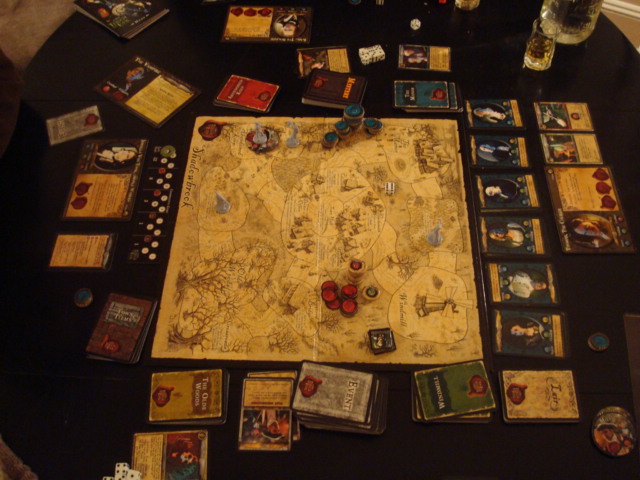
Another aspect of the components that really jumped out at me when I was opening the game was how small the actual game board is. Really, it’s almost tiny which I found to be silly. Then we played and noticed how many peripherals wind up surrounding the game. There are numerous stacks of cards, counters, minions, the villain sheet, the characters, and others. Taking those into account the game actually has a pretty big footprint on one’s gaming table. So clearly it was a good idea to make the board on the smaller side, otherwise it would actually be pretty gigantic.

The object of the game is to hunt down the creature to it’s lair and defeat it in combat, thus saving the town. There are four possible villains operating behind the scenes. The Spectral Horseman, Vampire, Werewolf, and Scarecrow each have different powers and minions to unleash on the heroes. It is also possible for no player to emerge victorious and for evil to triumph. The game contains a shadowtrack that starts at 20, throughout the game certain actions cause it to go down. If the shadowtrack ever goes below 1 then the game is lost as the villains hold on Shadowbrook becomes complete. Scary times. The cost of purchasing a lair card also decreases as the shadowtrack moves down, which figures into the strategy in the game.

The game itself plays pretty easy for the most part, though the end showdown with the villain seems a little bit confusing. Players go in order (beginning with the First Player, a title which moves each round) and only have a couple of choices available to them. They roll and move around the board, fight any monsters they may pass, and then encounter the space that they are in. Encountering the space can produce a myriad of results; from being attacked by a minion, finding a treasure, drawing an event card, and others. After this they can also purchase a lair card, peek at a town elder’s secret, or heal a wound. Very easy to manage. After each player has done this a Mystery card is drawn and the results applied. The Mystery card represents the villain exerting his power over the area and usually has negative consequences for everyone involved. It’s similar to the Infection deck in Pandemic or the Black cards in Shadows Over Camelot.


When a lair card has been purchased a player may travel to the location named on the card and fight the villain, with victory in this combat winning the game. The villains are very tough and help is usually required in the battle, help which takes the form of the town elders. A group of six mysterious citizens, the elders come to the aid of the hero in the climactic showdown. Before the fight begins the hero has the option of taking up to two of these people to assist in his fight, but there is a twist. At the start of the game each elder is randomly given a secret card. Some of the secrets have no effect, some have a positive affect, and others are negative and take the form of the elder secretly plotting with the villain. Because of this it is essential that the player investigate the elders before enlisting their aid, it’s a nasty surprise to find out that your ally Lord Holbrook is actually in cahoots with the evil Scarecrow. Once an elder has been revealed as evil he stays with the villain for the rest of the game. I think. This is one of the areas where the game is not all that clear on what happens. My biggest complaint with the showdown is that in both of the games that we played the same thing happened. One of the players challenged the villain and damaged it, but eventually came up short. Right after this the next player challenged it and was able to defeat it because the villain did not have a chance to heal it’s wounds. It doesn’t seem all that heroic to sneak up on the vampire and take him out because someone else brought him to death’s door.

The general theme of the game is that the players are investigating the mystery and ultimately trying to track the villain down to his lair and slay it. Feeding into this players collect investigation points for most things that they do. Battle a minion and kill it? Get some investigation points to reflect what you learned from it. Encounter a creepy scene in the Abandoned Keep? Investigation points represent clues left at the spot. Investigation points are essentially the currency of the game and can be used to purchase items, learn secrets, and hunt down the monster.

The heroes in the game are an interesting mix of colonial types. We’ve got a soldier, some nobles, an investigator, even a playwright. The characters in the game all have a special ability or two, and a score in four attributes; Spirit, Cunning, Combat, and Honor. These stats are frequently used to determine the success of an investigation using a target number system. Example: when encountering a ghost in the Olde Woods a player is required to make a 5+ Spirit check, with each result garnering an investigation point. Say you have a Spirit of 3, you would then roll 3 dice and each result of 5 or higher counts as a success and gets you a point. Areas of the board focus on certain skills, so it makes sense to hang around the Windmill if Cunning is a strongpoint for your character.

Combat is also an integral part of the game, with the heroes frequently finding themselves waylaid by Barghest Hounds and Ghost Soldiers. One of the aspects of combat that I do like is that all the rolls are resolved simultaneously, so even if you kill the Feral Kin in one round it still has a chance to inflict some wounds on you. One of the odder aspects of combat, and one that I don’t like as much, is that you can’t really get killed. If a character fills up all their wound markers they are merely moved back to Town Hall, with no long term loss. Due to the sequence of the turn though it may result in the loss of a turn for the character if they are defeated turning the Mystery phase, rather than during their turn.

I’m a fan of games that are able to weave together good mechanics with a plot that works well with the game elements, and this is something that TOE does really well. I like the way that the Mystery cards show the power and influence of the villain in a sneaky way. Like any good mastermind they deal from the shadows and operate in back channels. They assassinate elders, send out henchmen, and corrupt the townsfolk. There is nothing groundbreaking about the way that the game runs, I feel like I’ve seen a variation of just about all the rules in one game or another. But that should not take away from the fun of the game, which is in ample supply.