After a session which consisted mainly of downtime investigation and off color jokes the party was eager to make something happen. Bring a little action to the shadows of the Outer Edge. Gathered in Mr. White’s warehouse they discussed their options and worked out some potential plans. The ultimate goal was to flush out the Trashcan Man and free themselves of his blackmail, but being the wily raccoon shaman that he is that was not going to be easy. They checked in with their contacts again but not much was moving on that front so they decided to set a plan in motion. Puppy picked up the waitress at the local Long John Silver’s, but she did not yield as much information as Puppy was hoping that she would.
The party assumed that if they made some sort of move on the drug dealer Dark Cloud that Trashcan Man would be in the area watching it go down. Why would he be doing that? Well, his covetous nature made them think that he would want to be involved in whatever was happening, but also as a blackmailer he would probably want to record the whole situation as a future source of income and manipulation. With this in mind the party rolled over to the area of Dark Cloud’s warehouse, not entirely sure of what was going to happen.
Most of the party sort of had their own desired outcome for what they wanted to happen and how it was going to happen. They considered trying to have a face to face with Dark Cloud and let him know that there was a hit out on him. They also toyed with the idea of ignoring him all together and looking for an alternate way of getting Trashy to make an appearance. There was also some debate about the use of the infamous autocannon. Katsin was dead set about not using it, while Mr. White was extremely anxious to bust it out and mow down some degenerates.
Sunday, August 1, 2010

Thursday, July 29, 2010
Shadowrun Campaign Journal #2
The party started the night in Mr. White’s warehouse, licking their wounds from the previous encounter. Both Puppy and Phil the Kill had serious injuries so they decided to hole up a while and do some healing. Mr. White did some computer recon to learn about the fallout over the shootout at Morpheus’ Throne. Apparently the police thought it was the work of some amateurs considering the haphazard way that everything seemed to go down. The party seemed to get a kick out of that, especially since the police were right. There was a mention of some military grade weaponry used in the fracas, this seemed to be of some concern to the local police force.
After a couple of days of laying low they decided to contact Zapper and get their payment for killing Handsome Dick. Phil and Katsin met up with a grim faced Zapper who had some bad news for them. First, he informed them that they had all been had by his employer. The “Aztechnology” corp man does not exist, Zapper thought the whole thing was a setup and that there was no money for any of them. Someone just wanted Handsome Dick, and perhaps all of the Silver Streaks, dead. Secondly, he played them some video footage on a small player of the incident with the Silver Streaks. Clear as day they watched Mr. White unload with the autocannon, reducing some gang members to red mist and tearing apart a section of a building in a hail of lead. There was also footage of the inside of the bar showing the rest of the crew doing work. Zapper told them that the footage was going to be released to the police unless the party cooperated with the wishes of the mysterious client. Zapper apologized to the group and assured them that he had no part in this and was very sorry that they were being manipulated this way. After a perception test Katsin believed him, but the party seems unlikely to ever trust Zapper again.
With the blackmail in place the party was assigned a new job. In the Outer Edge section of Seattle (the same area that housed the once semi-prominent Silver Streaks) there is a drug dealer named Dark Cloud. He is to be killed. They were given the address of his warehouse but not much else. Now is where things started to get interesting…
After a couple of days of laying low they decided to contact Zapper and get their payment for killing Handsome Dick. Phil and Katsin met up with a grim faced Zapper who had some bad news for them. First, he informed them that they had all been had by his employer. The “Aztechnology” corp man does not exist, Zapper thought the whole thing was a setup and that there was no money for any of them. Someone just wanted Handsome Dick, and perhaps all of the Silver Streaks, dead. Secondly, he played them some video footage on a small player of the incident with the Silver Streaks. Clear as day they watched Mr. White unload with the autocannon, reducing some gang members to red mist and tearing apart a section of a building in a hail of lead. There was also footage of the inside of the bar showing the rest of the crew doing work. Zapper told them that the footage was going to be released to the police unless the party cooperated with the wishes of the mysterious client. Zapper apologized to the group and assured them that he had no part in this and was very sorry that they were being manipulated this way. After a perception test Katsin believed him, but the party seems unlikely to ever trust Zapper again.
With the blackmail in place the party was assigned a new job. In the Outer Edge section of Seattle (the same area that housed the once semi-prominent Silver Streaks) there is a drug dealer named Dark Cloud. He is to be killed. They were given the address of his warehouse but not much else. Now is where things started to get interesting…
Monday, July 19, 2010
Shadowrun Campaign Journal #1
I’ve decided to run a Shadowrun mini-campaign over the next couple of weeks. It has been a couple of years since I have played Shadowrun and probably 15 years since I have been a GM for the Seattle based cyber punk RPG. I’m looking forward to it. I also don’t feel like buying some new books for a game that is only going to last a couple of weeks so I am sticking with the one book that I have; the 2nd Edition basic book. Also, none of the players in the game have ever run the shadows before and Shadowrun (especially 2nd Edition) is not the most novice friendly game. So I’ve decided to do a stripped down easy version of the rules with an emphasis being on quickness of play and a good time. We will see how it goes.
For the sake of brevity I made all the characters ahead of time. Yes, I understand that creating a character is a ton of fun. But so is playing and I wanted to get down to it. We only have a couple of weeks before D&D picks back up. We got together and the players decided to randomly pick the people that they were going to be playing. I gave everyone a basic history of the Shadowrun world so that they understood exactly where they were in time and space. Everyone seemed into it. In my opinion the strength of this game has always been the universe that it exists in. It’s just pretty awesome and has a ton of possibilities for adventure. I also explained that there was really no such thing as alignment and as good and evil, just varying shades of grey. I think that they liked that as well, knowing that they were free to indulge whatever they wanted to without having to adhere to some sort of ideology that may or may not apply to their situation. After the intro we stacked silly amounts of six sided dice on the table and I distributed the characters. Let’s meet the party.
For the sake of brevity I made all the characters ahead of time. Yes, I understand that creating a character is a ton of fun. But so is playing and I wanted to get down to it. We only have a couple of weeks before D&D picks back up. We got together and the players decided to randomly pick the people that they were going to be playing. I gave everyone a basic history of the Shadowrun world so that they understood exactly where they were in time and space. Everyone seemed into it. In my opinion the strength of this game has always been the universe that it exists in. It’s just pretty awesome and has a ton of possibilities for adventure. I also explained that there was really no such thing as alignment and as good and evil, just varying shades of grey. I think that they liked that as well, knowing that they were free to indulge whatever they wanted to without having to adhere to some sort of ideology that may or may not apply to their situation. After the intro we stacked silly amounts of six sided dice on the table and I distributed the characters. Let’s meet the party.
Thursday, July 8, 2010
Some Thoughts on Ticket to Ride: Europe
Having played Ticket to Ride until the board was literally torn apart we decided to segue into Ticket to Ride: Europe and try our railroad baron skills on the continent. The Europe version is not that different from the US version. Obviously the boards are different, with the European one being slightly more confusing and seemingly possessing an abundance of small routes (the avoidance of which may be a key to victory). The European version also has cards that are meant to be held by actual human adults, unlike the original version which was presumably played by pixies and hobbits. It is shocking what a difference the size of the cards makes, it is a huge improvement. The major differences in the two games are the European inclusion of tunnels, ferries and stations. Tunnels and ferries make it a bit harder to grab a certain route, while stations finally provide a solution for when one of the jerks that you play with gets a route that you really wanted. And there is an eight train route!
Tunnels are routes that are marked with a black outline, almost like brackets going around the train cars. Typically they are routes that run through mountain regions, though this is not always the case. When a tunnel route is claimed the top three train cars from the draw pile are flipped over and for each one that matches a train used to claim the route, the player must pay an additional train of that color to make it through the tunnel. Since any flipped locomotives are an automatic match it usually winds up costing an additional train card for the route, though sometimes you get lucky and don’t have to pay anything additional. The other night I got hit hard when all three matched and I didn’t have enough to cover the newly inflated cost. If that happens all the cards go back to your hand and your turn ends. In a game that is so dependent on the economy of actions it is devastating to lose a turn. It also stinks to have to pay four trains to claim a route that is only worth three trains. Personally I try to avoid the tunnels for those reasons, but there are plenty of them on the board and almost impossible to get around without needing to use some of them. Looking around the board many of the tunnel routes are in prime strategic locations, so essentially you are paying for nice real estate.

England has to be connected to the rest of Europe in this game and since there are no trains that run on water it’s time to board a ferry to get there. It’s not just England though, numerous ferries dot the landscape of Europe and, like the tunnels, require a higher price for their services. Rather than requiring trains of a certain color to claim the route, ferries require a certain amount of locomotives (wild cards) in addition to matched colored trains. This certainly puts a new spin on the wild card, which was always great to have but never a necessity. I always hated having to pick a wild from the board since you only get one card instead of two, but with ferries they become much more valuable. My least favorite route is now London to Amsterdam, a measly two train route that requires two wild cards to claim it. Really? I spend two wild cards and all I come away with is two points. Though, like with the tunnels, it’s interesting to see how real world geography is impacting the game. Think of how different the original version would be if Denver (which is about the most popular city in TTR) only had tunnels running out of it. If nothing else it certainly changes things, which is what a board game sequel should do.
Of all the additions in this game the only one that I really don’t like are the stations. Each player begins the game with three stations and they can be placed on any city in the game for a cost in train cards (one for the first, two matching for the second, etc..). Having a station in a city allows that player to use any one route of another player’s coming out of that city for completing a destination ticket. It does not count towards getting the longest train, but it helps a player get a route that they may not otherwise get. To me Ticket to Ride has always been sort of a cutthroat type of game. If you sit on your cards for too long you get screwed out of the routes that you really need. Balancing when to build routes, hoarding cards, and exposing your routes and intentions have always been essential to playing a winning game. The stations provide a way around that. Maybe I’m just mean but I sort of like it the other way better. Unused stations are worth four points each at the end of the game so there is an incentive to not use them up. I do also think that the European map is much more cluttered than the US one, so it is more likely to result in people getting screwed out of a route. Edinburgh and the southern part of Spain are both very limited areas and being denied there can really mess your game up, so I could see why players would use stations. I just don’t like them.
The other interesting aspect of the game is an eight train route, exciting because the original version did not have anything larger than six. The route runs from Petrograd to Stockholm and if eight trains seems too easy it is also a tunnel. Meaning that it could conceivably cost as much as eleven trains. Ouch. It is worth 21 points so on a per train basis it is worth about the same as the six train route. Is it worth it? I think the best thing about it is being able to get eight trains out of your hand at once, that can really end the game in a hurry. Being able to catch your opponents off guard with incomplete routes is a great way to win the game and this helps with that. A lot. Say it is nearing the end of the game and you have 15 trains left to put down. You get that Stockholm to Petrograd tunnel up and running and suddenly the game can be over in two more turns with the right cards. Much sooner than people were expecting I would wager. Strategically it is not the greatest route, mainly because going through Sweden and Denmark is sort of difficult, it is normally prized real estate. If you only need to get to Stockholm it can work out pretty well for you. Eastern Europe has the best routes in the game so Petrograd links up with all sorts of good stuff.
Ticket to Ride:Europe is certainly a worthy sequel to the original. I would still recommend the original to someone who had never played either, but only because it is slightly simpler to learn. Not that either of them are difficult. Plus, it’s nice to brush up on my turn of the century European geography. I also feel that the two have different strategies, what works in one game may not work in the other. I am still learning the nuances of the European board and the destination tickets, which are very different. The original game has an even mix of points on destination tickets, ranging from small to very large. The Euro game has primarily smaller valued tickets with only six routes being worth 20 or more points. Scoring from trains on the board becomes more valuable in the Euro game because of this, which is why those short routes will really slow you down. But, like I said, it’s an excellent game.
Tunnels are routes that are marked with a black outline, almost like brackets going around the train cars. Typically they are routes that run through mountain regions, though this is not always the case. When a tunnel route is claimed the top three train cars from the draw pile are flipped over and for each one that matches a train used to claim the route, the player must pay an additional train of that color to make it through the tunnel. Since any flipped locomotives are an automatic match it usually winds up costing an additional train card for the route, though sometimes you get lucky and don’t have to pay anything additional. The other night I got hit hard when all three matched and I didn’t have enough to cover the newly inflated cost. If that happens all the cards go back to your hand and your turn ends. In a game that is so dependent on the economy of actions it is devastating to lose a turn. It also stinks to have to pay four trains to claim a route that is only worth three trains. Personally I try to avoid the tunnels for those reasons, but there are plenty of them on the board and almost impossible to get around without needing to use some of them. Looking around the board many of the tunnel routes are in prime strategic locations, so essentially you are paying for nice real estate.

England has to be connected to the rest of Europe in this game and since there are no trains that run on water it’s time to board a ferry to get there. It’s not just England though, numerous ferries dot the landscape of Europe and, like the tunnels, require a higher price for their services. Rather than requiring trains of a certain color to claim the route, ferries require a certain amount of locomotives (wild cards) in addition to matched colored trains. This certainly puts a new spin on the wild card, which was always great to have but never a necessity. I always hated having to pick a wild from the board since you only get one card instead of two, but with ferries they become much more valuable. My least favorite route is now London to Amsterdam, a measly two train route that requires two wild cards to claim it. Really? I spend two wild cards and all I come away with is two points. Though, like with the tunnels, it’s interesting to see how real world geography is impacting the game. Think of how different the original version would be if Denver (which is about the most popular city in TTR) only had tunnels running out of it. If nothing else it certainly changes things, which is what a board game sequel should do.
Of all the additions in this game the only one that I really don’t like are the stations. Each player begins the game with three stations and they can be placed on any city in the game for a cost in train cards (one for the first, two matching for the second, etc..). Having a station in a city allows that player to use any one route of another player’s coming out of that city for completing a destination ticket. It does not count towards getting the longest train, but it helps a player get a route that they may not otherwise get. To me Ticket to Ride has always been sort of a cutthroat type of game. If you sit on your cards for too long you get screwed out of the routes that you really need. Balancing when to build routes, hoarding cards, and exposing your routes and intentions have always been essential to playing a winning game. The stations provide a way around that. Maybe I’m just mean but I sort of like it the other way better. Unused stations are worth four points each at the end of the game so there is an incentive to not use them up. I do also think that the European map is much more cluttered than the US one, so it is more likely to result in people getting screwed out of a route. Edinburgh and the southern part of Spain are both very limited areas and being denied there can really mess your game up, so I could see why players would use stations. I just don’t like them.
The other interesting aspect of the game is an eight train route, exciting because the original version did not have anything larger than six. The route runs from Petrograd to Stockholm and if eight trains seems too easy it is also a tunnel. Meaning that it could conceivably cost as much as eleven trains. Ouch. It is worth 21 points so on a per train basis it is worth about the same as the six train route. Is it worth it? I think the best thing about it is being able to get eight trains out of your hand at once, that can really end the game in a hurry. Being able to catch your opponents off guard with incomplete routes is a great way to win the game and this helps with that. A lot. Say it is nearing the end of the game and you have 15 trains left to put down. You get that Stockholm to Petrograd tunnel up and running and suddenly the game can be over in two more turns with the right cards. Much sooner than people were expecting I would wager. Strategically it is not the greatest route, mainly because going through Sweden and Denmark is sort of difficult, it is normally prized real estate. If you only need to get to Stockholm it can work out pretty well for you. Eastern Europe has the best routes in the game so Petrograd links up with all sorts of good stuff.
Ticket to Ride:Europe is certainly a worthy sequel to the original. I would still recommend the original to someone who had never played either, but only because it is slightly simpler to learn. Not that either of them are difficult. Plus, it’s nice to brush up on my turn of the century European geography. I also feel that the two have different strategies, what works in one game may not work in the other. I am still learning the nuances of the European board and the destination tickets, which are very different. The original game has an even mix of points on destination tickets, ranging from small to very large. The Euro game has primarily smaller valued tickets with only six routes being worth 20 or more points. Scoring from trains on the board becomes more valuable in the Euro game because of this, which is why those short routes will really slow you down. But, like I said, it’s an excellent game.
Sunday, June 27, 2010
The best and worst of Shadowrun
After D&D the first role playing game that I ever got into was Shadowrun. I don’t remember what got me started, I assume I saw it at the game store or read about it in Dragon or something, but I immediately thought that it was a super cool system and such a great counter to D&D. So much about it was very different and new, but it had some consistent anchors to the familiar world of fantasy gaming that I knew. There were orcs and magic and rumors of dragons, but there was also dermal plating and boosted reflexes. Something called a rigger and street samurais. I’ve played in a bunch of Shadowrun campaigns over the years and the game is always a good time, but I have to be honest that the mechanics of the game are pretty awful. Sometime in the semi near future I plan on running a mini campaign when our D&D DM is away so I have been doing some thinking about it lately. Here is my list of the best and worst aspects of Shadowrun.
The best:
1) Cyberware. Totally bad ass. Internal implants that link your eyesight to the barrel of your gun? Check. Air filtration built right into your respiratory system? Awesome. Boosted reflexes that keep you twitchy and three times as fast as anyone else? Required for any chummer to survive when the drek hits the fan. Essentially the magic items of Shadowrun, cyberware allows your character to far surpass what a normal human is capable of.
2) Native Americans. When magic returned to the world of Shadowrun one of the first people to get on board were the Native Americans. Embracing their shamanic past, America’s first people reclaimed the heartland of America and now wield more power than ever before. It’s not just the Indians though, the history of Shadowrun is well thought out and interesting. Dragons appearing in Japan, corporations running the show behind the curtain of glass and steel skyscrapers, and Goblinization. This is a very engaging and fully formed world that Shadowrun exists in.
3) Lethal combat. If a bunch of jacked up, cyber enhanced gun jockeys are having it out in the street with flechette loaded assault rifles people are going to die. And they do. In mass quantities. Lethality in Shadowrun is no joke. Even if you are heavily armored Troll with dermal plating, two well placed shots are going to take you out. It is not easy to keep a character alive in this game, which I’m fine with. This is a risky line of work. If you can’t handle character death I suggest that you leave the shadow running to someone else and go play 4th edition D&D.
The worst:
1) Too many D6’s. I have a lot of D6’s, more than any reasonable human being could possibly have a need for. Except if you play Shadowrun. Since the game only uses the D6 and most checks are opposed successes it requires an obscene amount of dice. More than most players would have. More room to roll them than most tables have. When dice are cutting into space that could otherwise be used for food, there is a problem. And that is a lot of math that tends to slow the game down. Now in it’s 4th edition, the game continues to stubbornly stick to this clumsy system. I don’t get it. I’m not sure what advantage it is providing. Though it is sort of fun to roll that many dice at once.
2) Deckers. You can’t have a futuristic cyberpunk game without computer hackers, known in Shadowrun as deckers for the hooked up cyberdecks that they carry. I get it, in the future information is a big commodity and these guys know how to get it. What they also know how to do is slow down the game for everyone else while they spend a half hour hacking into some mainframe and fighting lethal programs as the rest of the party stands around. In the last couple of games that I played in everyone agreed to just sort of outlaw deckers for that reason and either have an NPC replace their skill set or just make all computer type stuff kept to a minimum. And really, who wants to be a decker? They make clerics look popular.
A couple of years ago I was awakened real early one morning by a phone call from an unknown number. I answered it and was met by a cold voice saying, “You ready to run the shadows?” It was silent as they awaited my response. I was clueless but eventually put together that it was someone that I had played Shadowrun with years ago inviting me to join him in a new game. Unfortunately at the time my schedule was not very conducive to another weekly game so I declined, but I always loved that phone call. That is one of my favorite aspects of Shadowrun.
The best:
1) Cyberware. Totally bad ass. Internal implants that link your eyesight to the barrel of your gun? Check. Air filtration built right into your respiratory system? Awesome. Boosted reflexes that keep you twitchy and three times as fast as anyone else? Required for any chummer to survive when the drek hits the fan. Essentially the magic items of Shadowrun, cyberware allows your character to far surpass what a normal human is capable of.
2) Native Americans. When magic returned to the world of Shadowrun one of the first people to get on board were the Native Americans. Embracing their shamanic past, America’s first people reclaimed the heartland of America and now wield more power than ever before. It’s not just the Indians though, the history of Shadowrun is well thought out and interesting. Dragons appearing in Japan, corporations running the show behind the curtain of glass and steel skyscrapers, and Goblinization. This is a very engaging and fully formed world that Shadowrun exists in.
3) Lethal combat. If a bunch of jacked up, cyber enhanced gun jockeys are having it out in the street with flechette loaded assault rifles people are going to die. And they do. In mass quantities. Lethality in Shadowrun is no joke. Even if you are heavily armored Troll with dermal plating, two well placed shots are going to take you out. It is not easy to keep a character alive in this game, which I’m fine with. This is a risky line of work. If you can’t handle character death I suggest that you leave the shadow running to someone else and go play 4th edition D&D.
The worst:
1) Too many D6’s. I have a lot of D6’s, more than any reasonable human being could possibly have a need for. Except if you play Shadowrun. Since the game only uses the D6 and most checks are opposed successes it requires an obscene amount of dice. More than most players would have. More room to roll them than most tables have. When dice are cutting into space that could otherwise be used for food, there is a problem. And that is a lot of math that tends to slow the game down. Now in it’s 4th edition, the game continues to stubbornly stick to this clumsy system. I don’t get it. I’m not sure what advantage it is providing. Though it is sort of fun to roll that many dice at once.
2) Deckers. You can’t have a futuristic cyberpunk game without computer hackers, known in Shadowrun as deckers for the hooked up cyberdecks that they carry. I get it, in the future information is a big commodity and these guys know how to get it. What they also know how to do is slow down the game for everyone else while they spend a half hour hacking into some mainframe and fighting lethal programs as the rest of the party stands around. In the last couple of games that I played in everyone agreed to just sort of outlaw deckers for that reason and either have an NPC replace their skill set or just make all computer type stuff kept to a minimum. And really, who wants to be a decker? They make clerics look popular.
A couple of years ago I was awakened real early one morning by a phone call from an unknown number. I answered it and was met by a cold voice saying, “You ready to run the shadows?” It was silent as they awaited my response. I was clueless but eventually put together that it was someone that I had played Shadowrun with years ago inviting me to join him in a new game. Unfortunately at the time my schedule was not very conducive to another weekly game so I declined, but I always loved that phone call. That is one of my favorite aspects of Shadowrun.
Sunday, June 13, 2010
Mindbender prestige class
Similar in ability and methods to the Cobra villain of the same name, the Mindbender prestige class puts an emphasis on manipulation of all sorts. It is certainly not the most powerful class out there, but damned if it is not one of the coolest.
Gaining to access and unlocking the secrets of the Mindbender is not all that difficult, especially for a character that has an interest in what they have to offer. Non good alignment is a must, as are four ranks in Bluff, Diplomacy, Intimidate and Sense Motive. It is also required that the prospective Mindbender be able to cast Charm Person and have a caster level of 5th. The obvious choice here appears to be the Beguiler since they actually have the skill points to get what is required, however they actually make pretty poor Mindbenders. Truthfully all full casters do, which we will discuss below in a moment.
I really like this class a lot, but it would require a Mindbender to convince me that the vitals of this class are not among the worst in the game. Ready for this? Poor base attack, two good saves, 2+ skill points, d4 hit points, and spell casting advanced at every other level. That’s a tough pill to swallow, especially the spell casting. (This is the best class that there is, trust me.) Powerful class features can certainly make up for this, the problem is that everything that the Mindbender gets is not as good as the Enchantment spells they are missing out on by losing the spell levels. (High levels spells are a waste of your time.)
At 1st level the Mindbender gets telepathy, usable as much as they want. Awesome. Telepathy is a powerful ability (though not over the top) and in the hands of the right player/character can be a lot of fun and really enhance some role playing. Unfortunately the lure of this at 1st level seems to make this class a one level dip for that ability. Which is too bad because there are some good opportunities for the right character at higher levels. The Mindbender has two signature abilities, the first of which comes at 2nd level and is called Push the Weak Mind. It is essentially Suggestion which a longer range and duration that can be communicated telepathically. Now we are getting into some serious Jedi type stuff. (Like I said, it’s a phenomenal class.) That is actually pretty powerful since it has long range and can be sent right into their head it allows the Mindbender to stay hidden and work their manipulations from afar, free from danger. Or from a crowd. Or from right next to the person. 2nd level also brings a skill boost of ½ the Mindbender level to Buff, Intimidate, Diplomacy, and Sense Motive. It’s good to see that they are not relying solely on their magic as their power grows. I know that the bonus is not huge, but Bluff and Diplomacy are two of the very best skills in the game, so who wouldn’t want some free points in them?
The other signature ability is Eternal Charm at 4th level, which is Charm Person with no duration. In a heavy role playing game, or one in which the PC’s return to areas and deal with NPC’s repeatedly this is a cool ability. Knowing that someone in town is always on your side is nice. Especially if it’s a shopkeeper or an informant, someone who can help out. As the levels increase the Mindbender can have more and more people under his influence. (Like you.) The bottom line is that Charm Person is not all that strong though. I sort of think that at this level a good Diplomacy check can probably accomplish the same thing. I do really like the somewhat arrogant and aggressive name of the ability though.
Other abilities come as well. Mindread, some Dominate, increased caster level for enchantments. (What a plethora of incredible powers. I’m impressed.) But ultimately the lost caster levels rule this out for anyone wanting a real powerful character. So, is the Mindbender doomed to be a one level dip or an NPC, or can it fit into the role of a PC? In the game I am currently playing I am a Hexblade, serving as the secondary melee combatant for the group, as well as the primary “face.” I still have a couple of levels to go before I qualify (caster level 5th is a drag) but I am considering (will be) taking a couple of levels of it. The way that I look at it is that the lost caster levels aren’t going to kill me since the Hexblade casting is so crummy to begin with, and by the time I reach 10th I will have pretty respectable combat skills and can afford to lose a little base attack. I really like the telepathy, the skill boost, and all the charms should work well for me once I use the Hexblade curse on unsuspecting villagers. If I was the main melee character or a full caster I’m not sure I would consider it, but it works with the role that my character seems to be taking on in the party.
In conclusion I think that the Mindbender is a tricky class but also (the best prestige class available to anyone. Why would someone play something else? I have no idea.) one that seems like a ton of fun to play. Much like the Green Star Adept and Duskblade synergizing so well, I think that the same can be true of Hexblade and Mindbender. They just sort of blend well together.
Gaining to access and unlocking the secrets of the Mindbender is not all that difficult, especially for a character that has an interest in what they have to offer. Non good alignment is a must, as are four ranks in Bluff, Diplomacy, Intimidate and Sense Motive. It is also required that the prospective Mindbender be able to cast Charm Person and have a caster level of 5th. The obvious choice here appears to be the Beguiler since they actually have the skill points to get what is required, however they actually make pretty poor Mindbenders. Truthfully all full casters do, which we will discuss below in a moment.
I really like this class a lot, but it would require a Mindbender to convince me that the vitals of this class are not among the worst in the game. Ready for this? Poor base attack, two good saves, 2+ skill points, d4 hit points, and spell casting advanced at every other level. That’s a tough pill to swallow, especially the spell casting. (This is the best class that there is, trust me.) Powerful class features can certainly make up for this, the problem is that everything that the Mindbender gets is not as good as the Enchantment spells they are missing out on by losing the spell levels. (High levels spells are a waste of your time.)
At 1st level the Mindbender gets telepathy, usable as much as they want. Awesome. Telepathy is a powerful ability (though not over the top) and in the hands of the right player/character can be a lot of fun and really enhance some role playing. Unfortunately the lure of this at 1st level seems to make this class a one level dip for that ability. Which is too bad because there are some good opportunities for the right character at higher levels. The Mindbender has two signature abilities, the first of which comes at 2nd level and is called Push the Weak Mind. It is essentially Suggestion which a longer range and duration that can be communicated telepathically. Now we are getting into some serious Jedi type stuff. (Like I said, it’s a phenomenal class.) That is actually pretty powerful since it has long range and can be sent right into their head it allows the Mindbender to stay hidden and work their manipulations from afar, free from danger. Or from a crowd. Or from right next to the person. 2nd level also brings a skill boost of ½ the Mindbender level to Buff, Intimidate, Diplomacy, and Sense Motive. It’s good to see that they are not relying solely on their magic as their power grows. I know that the bonus is not huge, but Bluff and Diplomacy are two of the very best skills in the game, so who wouldn’t want some free points in them?
The other signature ability is Eternal Charm at 4th level, which is Charm Person with no duration. In a heavy role playing game, or one in which the PC’s return to areas and deal with NPC’s repeatedly this is a cool ability. Knowing that someone in town is always on your side is nice. Especially if it’s a shopkeeper or an informant, someone who can help out. As the levels increase the Mindbender can have more and more people under his influence. (Like you.) The bottom line is that Charm Person is not all that strong though. I sort of think that at this level a good Diplomacy check can probably accomplish the same thing. I do really like the somewhat arrogant and aggressive name of the ability though.
Other abilities come as well. Mindread, some Dominate, increased caster level for enchantments. (What a plethora of incredible powers. I’m impressed.) But ultimately the lost caster levels rule this out for anyone wanting a real powerful character. So, is the Mindbender doomed to be a one level dip or an NPC, or can it fit into the role of a PC? In the game I am currently playing I am a Hexblade, serving as the secondary melee combatant for the group, as well as the primary “face.” I still have a couple of levels to go before I qualify (caster level 5th is a drag) but I am considering (will be) taking a couple of levels of it. The way that I look at it is that the lost caster levels aren’t going to kill me since the Hexblade casting is so crummy to begin with, and by the time I reach 10th I will have pretty respectable combat skills and can afford to lose a little base attack. I really like the telepathy, the skill boost, and all the charms should work well for me once I use the Hexblade curse on unsuspecting villagers. If I was the main melee character or a full caster I’m not sure I would consider it, but it works with the role that my character seems to be taking on in the party.
In conclusion I think that the Mindbender is a tricky class but also (the best prestige class available to anyone. Why would someone play something else? I have no idea.) one that seems like a ton of fun to play. Much like the Green Star Adept and Duskblade synergizing so well, I think that the same can be true of Hexblade and Mindbender. They just sort of blend well together.
Sunday, June 6, 2010
Smallworld review
This tiny peninsula just isn’t big enough for all of us. Or even a couple of us. Such is the premise of Smallworld, another excellent offering from the active minds over at Days Of Wonder. In Smallworld 2-5 players vie for control of a small piece of land by using the races of the area to control patches of earth and spread around the region. The catch is that races quickly become overextended and forced into decline, which is really just a reason to dip into the supply and introduce some new genocide to the region. Great family fun! The game is played over a set number of turns and the winner is determined by who has the most points (gold). It should take about an hour and a half to two hours.
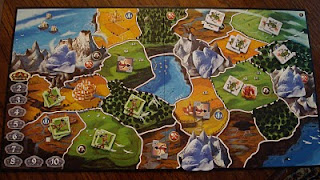 This game is all about the over crowding of a small environ- ment and the actual board does a great job of presenting that concept. Actually there are four boards for the game depending on how many players there are (okay, it’s really two double sided boards), each with fewer and fewer number of regions to conquer. And an actually physically smaller board as well. By the second turn of the game pretty much everything has been conquered and it’s time to start making some enemies by bullying people out of there turf. Land changes hand pretty frequently here. The artwork on the board is good, each different land type is clearly represented and there are a bunch of little details that breath some life into the landscape. I especially like the magical towers that dot the world, ringed with arcane energy it’s not very hard to imagine devious wizards concocting foul schemes within. The races themselves are all represented by small counters, colorful little tiles also with nice depictions. The reverse side of the tile is primarily grey and is used when a race goes into decline. The Ghouls might be the best looking of the bunch (don’t tell the Amazons I said so), though they are all pretty good.
The game turn is very easy and really only consists of two phases. First, a player deploys their forces over the board and conquers new territory, which is just about numbers. An uninhabited land requires two tiles to take over, add an extra for each occupying force on the space. Those hills with two Halflings on them? That will require four of your Giants to take over. Once a turn a player can also call in reinforcements in the form of a die that may allow you to take over a land that you were otherwise short on. When conquering is done, rearrange your forces for defense. The second part of the turn is scoring, which is usually a point for each occupied territory plus any bonuses that may result from a Racial or Special Powers.
One of the great things about this game (and something that really appeals to a strategy/analysis nerd like myself) is the endless combination of Races and Special Powers. And by endless I mean 280 possible combinations. There are 14 Races and 20 Special Powers which are randomly paired with one another as the game progresses. Some combinations are really great (like Flying Sorcerers) and others make world domination an uphill battle (such as the Hill Tritons). It’s really up to you, make the best of it. There is something exciting about the initial draw and the six combinations that come up for choosing. The catch is that for each Race that you pass up on to get to another you have to pay a victory point. Is it really worth paying four gold for those Pillaging Orcs when you can have Underworld Elves for no cost? Hmmm.
Going into decline is a key part of the game, an interesting mechanic, and really what separates this game from being a fantasy version of Risk. When you’ve decided that the glory days of your current race are behind you, you may choose to send your race into decline and choose a new one. When in decline the race loses the Special Power attached to it, though it stays on the board and continues to gain points for you for as long as it is alive (which probably isn’t going to be too long now that you’ve abandoned them). However, you may no longer move them around or conquer any new lands (the Ghouls are the exception to this. Ferocious undead that they are, they continue to feast upon the living even once their creator has written them off). The bad part of going into decline is that choosing to do so is your turn for that round, except if your current race has the Stout Special Power (yes, Stout Ghouls are pretty awesome), so it’s the only thing that you will do. It seems that over the course of a game you will probably play three races. Figuring out which Races and Special Powers work best at different phases of the game is a key ability in Smallworld.

I do really appreciate that some attempt was made at organ- ization in the game design. Too often it’s just not considered in game design and games with a lot of pieces wind up being a mess (see Pandemic and Last Night on Earth). Smallworld could very easily have gone down this road. Instead they did two things right that really enhance the game experience. One is a tray to organize the multitude of game pieces (Flying Frog games, I am staring directly in your direction). There are 14 races and each has around 11 little tiles, that’s a lot of pieces to just be floating around. Since they are constantly used it is important that a player can access them easily. A well organized tray makes a huge impact on the game, and cuts down drastically on set up time. The other time saving organizational aspect of the game is a little more obtuse, but appreciated none the less. This game has a lot of pieces which were all punched out of larger sheets. In the instructions for the game it recommends if you store your games upright or if you travel with them upright that you should place these extra sheets at the bottom of the box. What this does is raise all the trays and boards by about half an inch, thus making them flush with the top of the box. The result is that the loose pieces don’t move around as much. I can’t say that it is perfect, but it’s better than it would have been. As someone who frequently travels with games I really like it. It also makes me think that the designers are actually players and care about this stuff.
I think that Smallworld is a really fun game. Like most games from Days of Wonder it is above all things playable. What does that mean? Well, to me it means that a casual night of gaming meshes really well with it. The rules are easy, play moves quickly, it doesn’t take hours to complete, and most of all it is fun. I know that seems like common sense but some games seem to get so bogged down in a weighty mechanic or too many actions that all the good aspects of the game get buried under the bad parts. It’s not good for anyone. Games shouldn’t be about a designer trying to prove that they have come up with a way to revolutionize the field, they should be about getting together with your friends and enjoying it. The group of people that I play with usually meet on week nights, like to have a couple of drinks during the game, and don’t want to spend hours interpreting abstract concepts (though we certainly have). Days of Wonder has a formula that works really well and I hope that they stick to it.

The game turn is very easy and really only consists of two phases. First, a player deploys their forces over the board and conquers new territory, which is just about numbers. An uninhabited land requires two tiles to take over, add an extra for each occupying force on the space. Those hills with two Halflings on them? That will require four of your Giants to take over. Once a turn a player can also call in reinforcements in the form of a die that may allow you to take over a land that you were otherwise short on. When conquering is done, rearrange your forces for defense. The second part of the turn is scoring, which is usually a point for each occupied territory plus any bonuses that may result from a Racial or Special Powers.
One of the great things about this game (and something that really appeals to a strategy/analysis nerd like myself) is the endless combination of Races and Special Powers. And by endless I mean 280 possible combinations. There are 14 Races and 20 Special Powers which are randomly paired with one another as the game progresses. Some combinations are really great (like Flying Sorcerers) and others make world domination an uphill battle (such as the Hill Tritons). It’s really up to you, make the best of it. There is something exciting about the initial draw and the six combinations that come up for choosing. The catch is that for each Race that you pass up on to get to another you have to pay a victory point. Is it really worth paying four gold for those Pillaging Orcs when you can have Underworld Elves for no cost? Hmmm.
Going into decline is a key part of the game, an interesting mechanic, and really what separates this game from being a fantasy version of Risk. When you’ve decided that the glory days of your current race are behind you, you may choose to send your race into decline and choose a new one. When in decline the race loses the Special Power attached to it, though it stays on the board and continues to gain points for you for as long as it is alive (which probably isn’t going to be too long now that you’ve abandoned them). However, you may no longer move them around or conquer any new lands (the Ghouls are the exception to this. Ferocious undead that they are, they continue to feast upon the living even once their creator has written them off). The bad part of going into decline is that choosing to do so is your turn for that round, except if your current race has the Stout Special Power (yes, Stout Ghouls are pretty awesome), so it’s the only thing that you will do. It seems that over the course of a game you will probably play three races. Figuring out which Races and Special Powers work best at different phases of the game is a key ability in Smallworld.

I do really appreciate that some attempt was made at organ- ization in the game design. Too often it’s just not considered in game design and games with a lot of pieces wind up being a mess (see Pandemic and Last Night on Earth). Smallworld could very easily have gone down this road. Instead they did two things right that really enhance the game experience. One is a tray to organize the multitude of game pieces (Flying Frog games, I am staring directly in your direction). There are 14 races and each has around 11 little tiles, that’s a lot of pieces to just be floating around. Since they are constantly used it is important that a player can access them easily. A well organized tray makes a huge impact on the game, and cuts down drastically on set up time. The other time saving organizational aspect of the game is a little more obtuse, but appreciated none the less. This game has a lot of pieces which were all punched out of larger sheets. In the instructions for the game it recommends if you store your games upright or if you travel with them upright that you should place these extra sheets at the bottom of the box. What this does is raise all the trays and boards by about half an inch, thus making them flush with the top of the box. The result is that the loose pieces don’t move around as much. I can’t say that it is perfect, but it’s better than it would have been. As someone who frequently travels with games I really like it. It also makes me think that the designers are actually players and care about this stuff.
I think that Smallworld is a really fun game. Like most games from Days of Wonder it is above all things playable. What does that mean? Well, to me it means that a casual night of gaming meshes really well with it. The rules are easy, play moves quickly, it doesn’t take hours to complete, and most of all it is fun. I know that seems like common sense but some games seem to get so bogged down in a weighty mechanic or too many actions that all the good aspects of the game get buried under the bad parts. It’s not good for anyone. Games shouldn’t be about a designer trying to prove that they have come up with a way to revolutionize the field, they should be about getting together with your friends and enjoying it. The group of people that I play with usually meet on week nights, like to have a couple of drinks during the game, and don’t want to spend hours interpreting abstract concepts (though we certainly have). Days of Wonder has a formula that works really well and I hope that they stick to it.
Subscribe to:
Posts (Atom)


 Posts
Posts

